Your First Period: Everything You Need to Know
A calm, complete guide to your first period: what to expect, what counts as normal, and what to do right now.
Published 27 July 2026
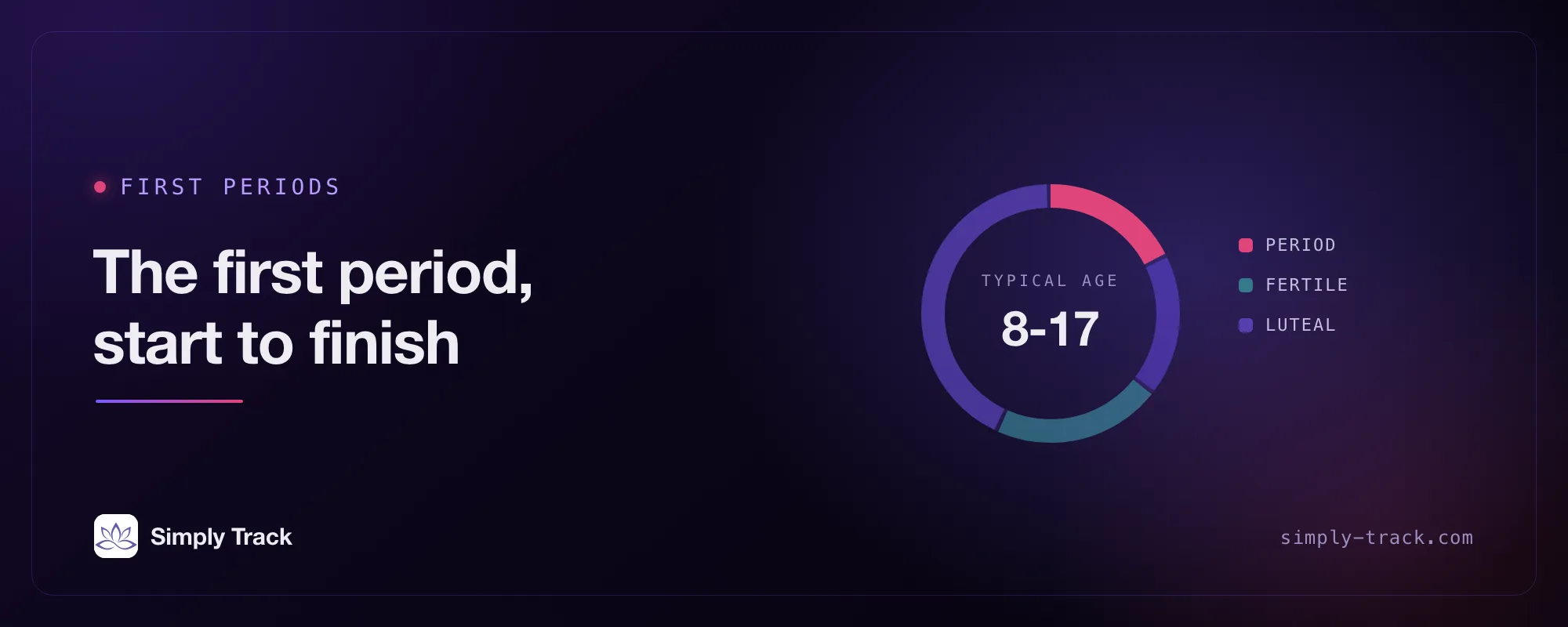
A first period is usually light, a small reddish-brown stain rather than a sudden flood (NHS). It typically arrives around age 12, and anywhere from 8 to 17 counts as normal. It can take a year or two to settle.
If you have not started yet and want to know what to watch for beforehand, Signs your first period is coming covers that in detail. This guide picks up from the day it actually arrives, and everything else that comes with it.
What a first period usually looks like
Most first periods are a small reddish-brown stain, not a heavy flow. The blood is often a little older by the time it appears, which is why the colour tends towards brown or dark red rather than bright red.
It might turn up as a mark on your underwear, or a stain on your sheets when you wake up, rather than announcing itself in advance (NHS). Once things settle into a rhythm, a full period involves losing about 20 to 90ml of blood in total, spread across the whole period (NHS). That works out to roughly 1 to 5 tablespoons. A first period tends to be lighter than that, and often shorter too.
Colour and amount can both vary a fair bit from one period to the next, and that is normal rather than a sign anything is wrong. If you notice small clots, or a smell that seems stronger than usual, Period blood: colour, clots and smell explained covers what is ordinary and what is worth a second look. For the fuller picture on what to expect day by day, see What does a first period look like?
What counts as normal at the start
There is a wide normal range, and it gets wider in the first year or two. Most periods start around age 12, anywhere from 8 to 17 counts as normal, and cycles can be uneven for a while before they find a rhythm.
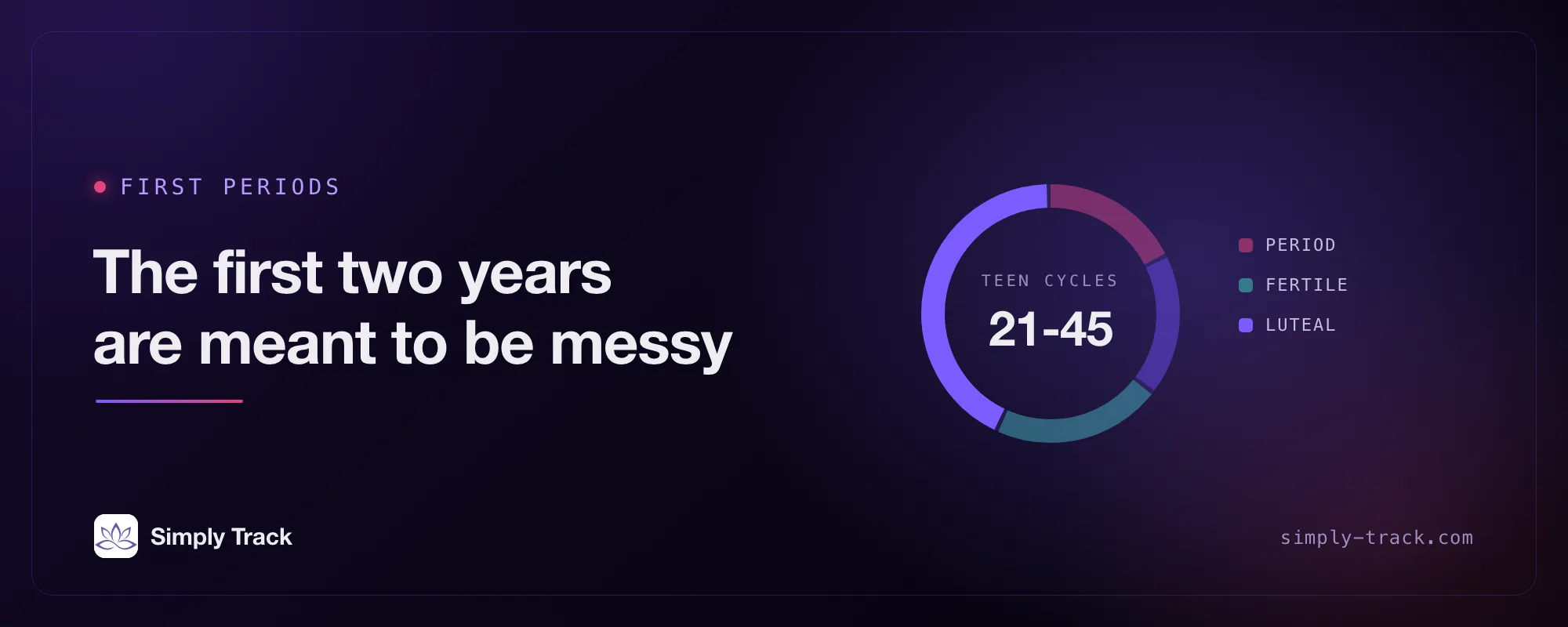
Periods usually begin about two years after the first signs of puberty, such as breast development (NHS). In the early years, adolescent cycles are naturally irregular. Clinical guidance puts around 90 per cent of adolescent cycles somewhere between 21 and 45 days apart (ACOG and AAP, Committee Opinion 651). Research following large numbers of teenagers found the 95th percentile for the gap between periods to be 90 days (Popat et al., 2008). That is a wide window on purpose. The part of the body that regulates the cycle is the connection between the brain and the ovaries, and it is still maturing. That is why early cycles can be shorter, longer, heavier or lighter than what comes later.
Once things settle, most cycles run every 23 to 35 days, with bleeding lasting 2 to 7 days (NHS). Getting there takes time. A cycle that jumps around for the first year or two is not, on its own, a reason to worry. What is normal for a first period? goes further into what a settling cycle actually looks like month to month.
What to do the moment it starts
Deal with the practical side first, then tell someone if and when you want to. Fold some toilet paper or use a spare pad if you have one, change into clean underwear if you can, and note the date.
There is no wrong way to handle the first few minutes. A wad of toilet roll works fine as a stopgap until you can get a proper pad or tampon. If you are at school, a teacher, school nurse or friend can point you towards supplies. Asking is far more ordinary than it feels in the moment. Telling a parent or carer is not compulsory, but most people find it easier once the news is out. That is often because someone else can then help with pads, spare underwear and knowing what to expect next.
Noting the date matters more than it seems. It becomes day one of your first tracked cycle, and having that starting point makes the next few periods easier to make sense of. For a calm, step-by-step walkthrough of exactly what to do and what to say, see I just got my first period. What do I do?
Products at a glance
Pads are the usual starting point, but they are not the only option. Tampons, period underwear, menstrual cups and discs all work too. Which one suits you can change from one period to the next, or even from one day to the next.
Pads stick to the inside of your underwear and are the easiest to learn on, which is why most people start there. Tampons sit inside the vagina and are an option many people move to once they feel ready to try them, often for swimming or sport. Period underwear looks and wears like ordinary underwear, with built-in absorbent layers, and works well as backup or on lighter days. Cups and discs also sit inside the vagina and are reusable, which can suit school terms and travel once you are confident using one.
None of these is more grown-up, more hygienic or more correct than the others. It is entirely normal to use different products for different days, or to try one and switch back to what you started with. Choosing your first period product compares them properly. How to put on a pad and How to use a tampon for the first time walk through the mechanics step by step. If tampons are on your mind, Are tampons safe for teenagers? answers the safety questions directly.
School, sport and everyday life
Nothing about school, sport or ordinary life has to stop for a period. A small kit in your bag, a plan for changing products, and knowing who to ask for help cover most of what comes up.
Keep a couple of pads or tampons, a spare pair of underwear and a sealable bag in your school bag. That way you are covered even if a period starts unexpectedly during the day. A jumper tied round your waist deals with a stain in the moment while you sort yourself out. Most schools keep spare supplies with the nurse, the office, or in bathrooms. Asking for one is far more common than it feels from the outside.
Swimming, PE and sport are all things you can do during a period. Showering, washing your hair and wearing whatever colour you like are also completely fine. A period does not stop any of that. First period at school and Build your school period kit cover the practical side in more detail. Swimming and sport on your period and Showering and sleeping on your period deal with the everyday questions people worry about most.
It is normal to feel whatever you feel
Whatever you feel about your first period is a normal reaction, whether that is nervous, relieved, embarrassed or not bothered at all. There is no correct way to feel, and plenty of people feel more than one thing at once.
Some people feel scared of the blood itself. Some feel embarrassed, or worry that everyone will somehow know. Some feel proud, or relieved that the waiting is over, and some feel genuinely neutral about the whole thing. It is common for friends to start before or after you, since the normal age range spans almost a decade. Being first or last among your friends says nothing about you or when your body was ready.
There is no toxic positivity here, and no pressure to feel a particular way just because that is how you are supposed to feel. It's okay to feel nervous about your first period goes into this properly, including what to do if it all feels like a lot at once.
When it is worth seeing a GP
See a GP if periods have not started by 15, or by 13 with no other signs of puberty, and also if bleeding is unusually heavy. Both are listed by the NHS as reasons to get checked. Neither is an emergency, just worth a conversation.
A GP visit at this stage is almost always about ruling things out and getting reassurance, not about anything being wrong. Signs worth mentioning include needing to change a pad or tampon every 1 to 2 hours, or bleeding that lasts well beyond 7 days (NHS). Also worth mentioning are periods that still have not settled into any kind of pattern within a couple of years of starting (ACOG and AAP, Committee Opinion 651).
A trusted adult, whether that is a parent, carer or school nurse, can help book the appointment and come along if that feels better. Seeing a GP does not mean anything is wrong. It means getting a proper answer instead of guessing, and most visits end with exactly that reassurance. What is normal for a first period? covers what is genuinely worth a GP appointment in more detail.
A note for parents, carers and dads
The most useful thing you can do is stay calm, matter-of-fact and ready before it happens. A short conversation, a stocked bag and knowing what is actually normal cover most of what a first period needs from the adults around a young person.
Talking about periods before they start, in small, ordinary conversations rather than one big one, takes the pressure off everyone. A basic kit (pads, spare underwear and a bag), kept somewhere easy to find, means the practical side is already sorted when it is needed. Knowing what is normal, including how uneven the first year or two of cycles can genuinely be, means you can tell the difference between ordinary variation and something worth a GP visit. It also means you can say so with confidence.
Dads and other male carers sometimes worry they are the wrong person to handle this. They are not. A dad's guide to your daughter's first period covers exactly what to say and what to buy, without any awkwardness or euphemism. Preparing your daughter for her period covers starting the conversation early, well before the first period actually arrives.
The short version
A first period is usually light and brief, most often a reddish-brown stain rather than a sudden flow. It typically arrives around age 12, and anywhere from 8 to 17 is normal. Cycles can take a year or two to settle into a steady rhythm of about 23 to 35 days, with bleeding lasting 2 to 7 days. Deal with the practical side first, then tell someone if and when you want to. See a GP if periods have not started by 15, or by 13 with no other signs of puberty, or if bleeding is unusually heavy.
Simply Track was built around the first period, not as an afterthought. Answering "it's my first period" during setup opens a free, step-by-step guide to what is happening and how to use pads, tampons, cups and more. That guide, along with period tracking and the calendar, stays free. A Premium subscription adds the daily Log, Insights and a doctor PDF report for later on. There is no account to create, no ads, and your data is never sold. Data stays on the device, with sync only to your own private iCloud if you choose to turn it on.
Sources
- NHS, Starting your periods: https://www.nhs.uk/conditions/periods/starting-periods/
- NHS, Periods: https://www.nhs.uk/conditions/periods/
- NHS, Heavy periods: https://www.nhs.uk/conditions/heavy-periods/
- ACOG and AAP Committee Opinion 651, Menstruation in Girls and Adolescents: Using the Menstrual Cycle as a Vital Sign: https://www.acog.org/clinical/clinical-guidance/committee-opinion/articles/2015/12/menstruation-in-girls-and-adolescents-using-the-menstrual-cycle-as-a-vital-sign
- Popat et al., Annals of the New York Academy of Sciences, The menstrual cycle: a biological marker of general health in adolescents: https://pmc.ncbi.nlm.nih.gov/articles/PMC2755071/
Common questions
How long does a first period usually last?
A period usually lasts 2 to 7 days, and a first period often falls at the shorter, lighter end of that (NHS). Timing can be uneven for the first year or two as the body settles into a rhythm, so a first period that is a little shorter or longer than expected is still normal.
Can your first period really take you by surprise?
For most people, no. The body usually gives signs beforehand, such as breast development and pubic or underarm hair growth, and periods typically start around two years after breasts begin growing (NHS). Even so, the day itself can still catch you off guard, which is why it helps to carry a pad or spare underwear once those signs appear.
What age is normal for a first period?
Most periods start around age 12, though anywhere from 8 to 17 is within the normal range, usually about two years after the first signs of puberty (NHS). There is no single right age. If periods have not started by 15, or by 13 with no other signs of puberty, it is worth seeing a GP.
Do I need to tell my parents when I get my first period?
There is no rule that says you must, but it usually helps. A parent, carer or another trusted adult can help you find products, manage school and know what is normal for you. If you would rather talk to a school nurse, teacher or older sibling first, that is okay too.
Not medical advice
General information, not medical advice. If something about your cycle worries you, speak to a GP.

Keep track of your own cycle
Simply Track logs your period on your iPhone and Apple Watch, and its predictions sharpen the more you record. Your data stays in your own iCloud account.