Period Blood: Colour, Clots and Smell Explained
Period blood shifts from red to pink or brown through a period, and a few small clots are common. Here is what actually needs a GP, and what does not.
Published 27 July 2026
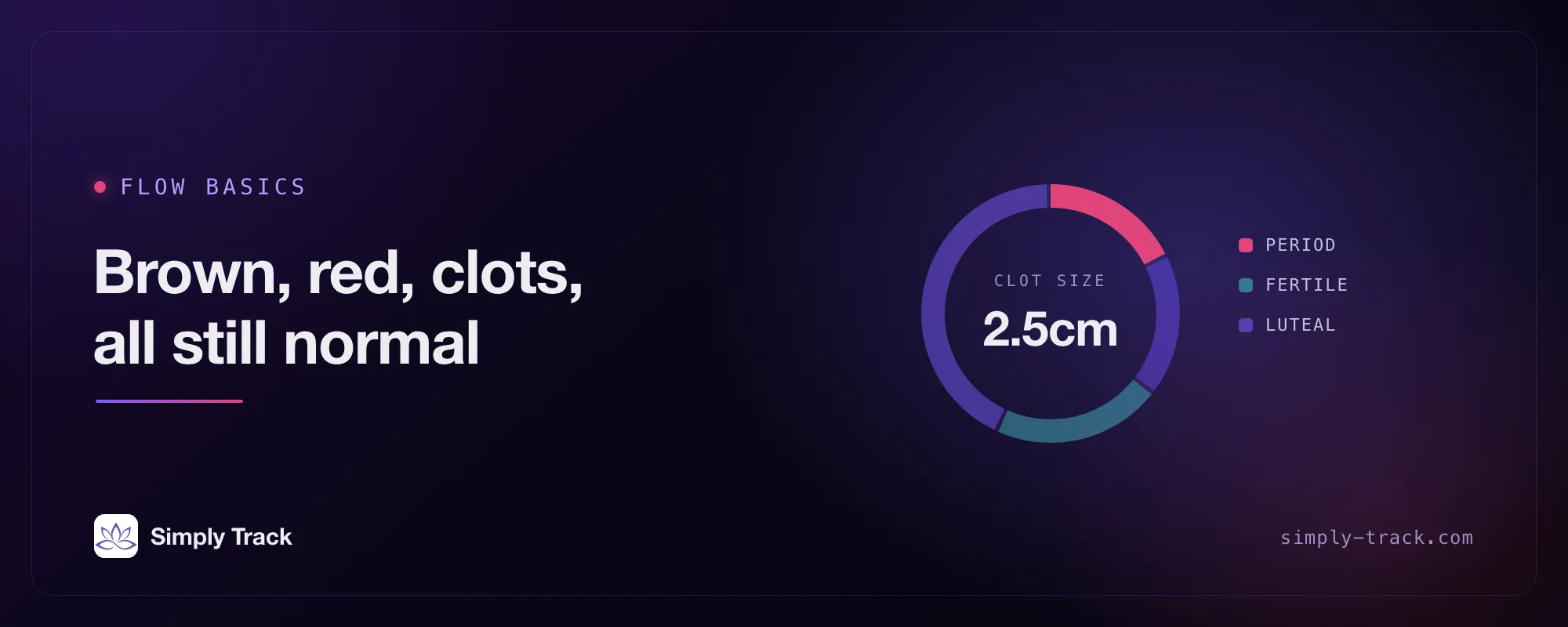
Period blood ranges from bright red to pink or brown, and all of it is normal. Small clots are common too. A strong or unusual smell, or clots that are regularly bigger than a 10p coin, are worth mentioning to a GP.
None of this needs to be a source of worry by itself. Colour, clots and smell all vary during a single period, and from one cycle to the next. There is a wide range of what counts as normal. Here is what typically happens, and the specific signs worth mentioning to a GP.
What colour is normal for period blood?
Period blood is usually red at its heaviest, and pink or brown on lighter days. This shift in colour through a period is completely normal. NHS guidance on periods says plainly that "when your period is at its heaviest, the blood will be red" and that "on lighter days, it may be pink or brown." The same pattern explains why a first period often looks different from a later, settled one. NHS guidance on starting periods describes it as usually a reddish-brown stain rather than a sudden gush. What Does a First Period Look Like? covers that specific case in more detail. Very dark brown blood towards the end of a period, when flow slows right down, is the same pattern taken further. On its own, it is not a sign that anything is wrong.
What about blood clots?
A few small clots are common, especially on the heaviest day or two. They are not something to worry about on their own. The NHS lists blood clots larger than about 2.5cm, roughly the size of a 10p coin, as one of several signs of a heavy period. Other signs include changing a pad or tampon every 1 to 2 hours, needing two products at once, bleeding for more than 7 days, or bleeding through to clothes or bedding. One large clot on an unusually heavy day is not automatically a problem. The NHS advises seeing a GP if heavy periods, including regular large clots, have been going on for some time or are affecting daily life. It also advises seeing a GP if there is bleeding between periods or after sex. What Counts as a Heavy Period? goes through the fuller picture, including what can cause it.
Why does a period smell, and when is it a problem?
A period normally has only a mild smell. On its own, that is nothing to worry about. The NHS does not treat period smell as its own separate topic. The closest match is its guidance on normal vaginal discharge, which mixes with period blood. It describes normal discharge as not having "a strong or unpleasant smell." The same guidance lists a change in smell, colour or texture as one reason to contact NHS 111 or see a GP. Other reasons include more discharge than usual, itching or soreness. A fishy smell in particular can point to bacterial vaginosis. The NHS describes this as a common cause of unusual discharge that is usually treated with antibiotics, so it is worth mentioning to a GP rather than guessing. NHS guidance on vaginal discharge advises washing with warm water and mild, non-perfumed soap. This is enough for everyday care. Can I Shower, Sleep In and Wear White on My Period? covers the everyday hygiene questions this one usually sits alongside.
What about discharge between periods?
Discharge between periods is normal and separate from a period itself. It changes through the cycle rather than staying the same every day. It often becomes clearer and wetter around ovulation. NHS guidance describes vaginal discharge as a fluid that keeps the vagina clean and protects it from infection. It notes that discharge is often more noticeable around ovulation, before settling again afterwards. That is different from bleeding or spotting between periods, which the NHS lists as a reason to see a GP, however light it is. It helps to notice what is usual for your own discharge, in the same way you might notice your own usual flow. That makes a genuine change easier to spot later.
When it's worth seeing a GP
Book a GP appointment if clots are regularly bigger than a 10p coin, a period lasts more than 7 days, or you are changing a pad or tampon every 1 to 2 hours. It's also worth booking if a smell, colour or discharge change does not settle. These are the specific markers the NHS lists for heavy periods and for discharge that needs a look, rather than a vague worry on its own. Bleeding between periods or after sex is also always worth mentioning, whatever else is going on. None of this means something is seriously wrong. It means there is a clear, specific reason to ask, and a GP would rather hear about it early than late. Anyone still at school or living at home might find it easier to tell a parent, carer or another trusted adult first. This gives support, and helps them know what to expect if an appointment follows.
The short version
Red on heavy days, pink or brown on lighter ones, and small clots now and then are all a normal part of a period. A few signs are worth a GP conversation: clots regularly bigger than a 10p coin, periods lasting more than 7 days, changing protection every 1 to 2 hours, or a smell or discharge change that does not settle. Everything else described here is just what a period normally does. Your First Period: Everything You Need to Know covers the rest of the basics in one place.
Simply Track's daily Log records flow, clots, products used and how a day actually felt. That builds a pattern to describe at an appointment, instead of relying on memory. The free first-period guide also walks through what is happening, and how to use pads, tampons, cups and more. Tracking, the calendar and every first-period guide are always free. The Log tab, Insights and a doctor-ready PDF report are Premium. They are built for exactly this kind of pattern.
Sources
- NHS, Periods: https://www.nhs.uk/conditions/periods/
- NHS, Starting your periods: https://www.nhs.uk/conditions/periods/starting-periods/
- NHS, Heavy periods: https://www.nhs.uk/conditions/heavy-periods/
- NHS, Vaginal discharge: https://www.nhs.uk/symptoms/vaginal-discharge/
- NHS, Bacterial vaginosis: https://www.nhs.uk/conditions/bacterial-vaginosis/
Common questions
Why is my period blood brown?
Brown period blood is simply blood that took longer to leave the body, giving it more time to change colour. NHS guidance says blood looks red at its heaviest and pink or brown on lighter days, and a first period is often described as a reddish-brown stain rather than a sudden gush. Both are normal.
Are period blood clots normal?
Yes, small clots are common, especially on the heaviest day or two of a period. The NHS treats clots larger than about 2.5cm, roughly a 10p coin, as one of several signs of a heavy period, worth mentioning to a GP if it becomes a regular pattern rather than a one-off.
Does period blood normally smell?
A period has a mild smell, and that is ordinary. The NHS describes normal vaginal discharge, which mixes with period blood, as not having a strong or unpleasant smell. A change in smell, especially a fishy one, is a reason to see a GP or contact NHS 111.
Not medical advice
General information, not medical advice. If something about your cycle worries you, speak to a GP.

Keep track of your own cycle
Simply Track logs your period on your iPhone and Apple Watch, and its predictions sharpen the more you record. Your data stays in your own iCloud account.