What Counts as a Heavy Period?
The old definition of a heavy period was a fixed number few people could ever apply to themselves. The current NICE definition asks a different question, whether it interferes with your life.
Published 27 July 2026
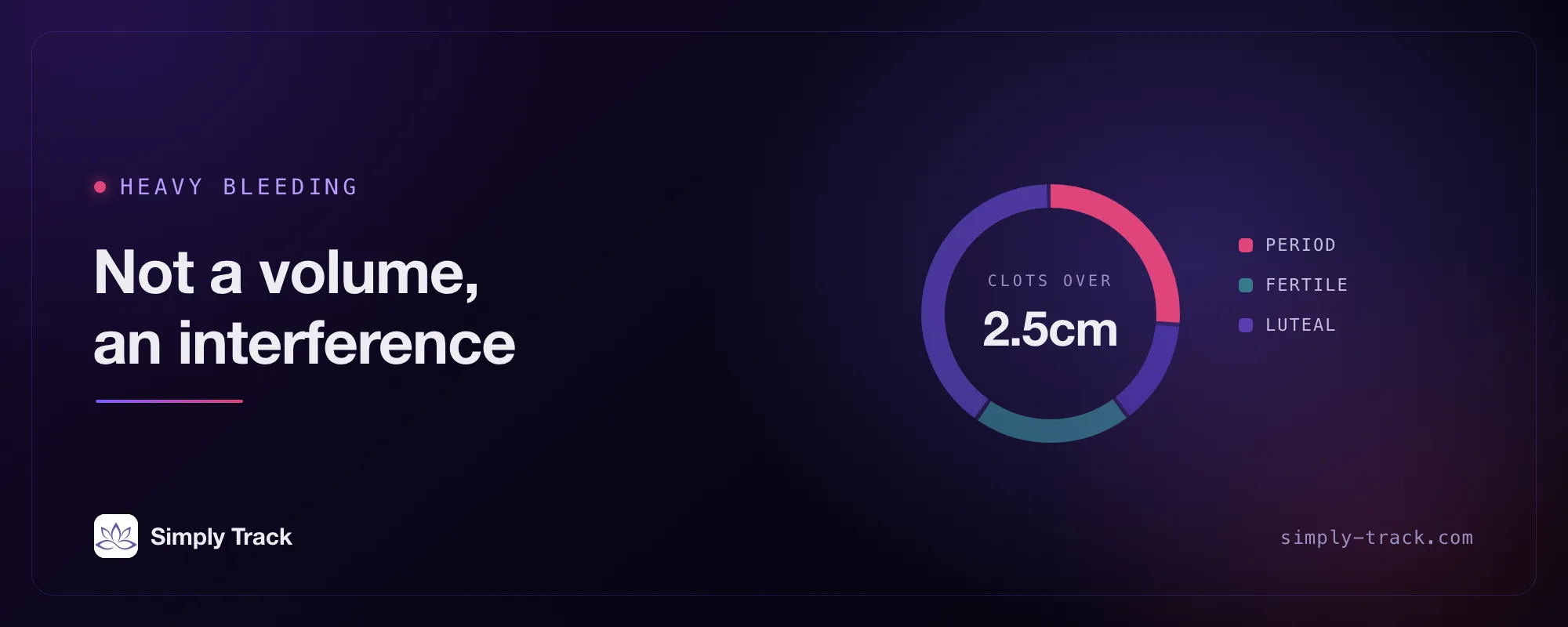
A heavy period is bleeding that interferes with your physical, social, emotional or material quality of life, not a fixed blood volume. That is NICE's current definition, and it replaced an old one built on a number.
NICE documents used to put heavy menstrual bleeding at 80ml or more of blood loss per cycle, measured across several cycles. In practice, NICE itself notes, that figure was rarely applied directly. Clinicians relied on the woman's own subjective assessment of blood loss instead, so the number decided nothing for the person actually bleeding.
Current UK guidance does not stop at redefining the number. It hands the whole assessment back to the person having the period.
How NICE actually defines it
NICE guideline NG88 defines heavy menstrual bleeding as "excessive menstrual blood loss which interferes with a woman's physical, social, emotional and/or material quality of life."
Read that again. There is no volume in it at all. The measure is interference.
NG88's very first recommendation tells clinicians to "recognise that heavy menstrual bleeding (HMB) has a major impact on a woman's quality of life, and ensure that any intervention aims to improve this rather than focusing on blood loss".
In practice, if your period dictates what you wear, where you go, whether you can sit through a meeting, or how far you will be from a toilet, that is heavy by the definition your GP is working to. Nobody is going to ask you for a millilitre count.
NG88 also asks clinicians to allow for the natural variability between people, and to explore care options with anyone who feels their bleeding falls outside what is normal for them. A change from your own usual pattern is worth mentioning.
The markers you can check yourself
The NHS lists seven practical markers of heavy periods, including changing protection every 1 to 2 hours, passing clots bigger than a 10p coin, and bleeding through to clothes or bedding.
Impact is the definition, but concrete markers help. In full, the NHS list is:
- Changing a pad or tampon every 1 to 2 hours, or emptying a menstrual cup more often than is recommended.
- Using two types of period product together, such as a pad and a tampon.
- Periods lasting more than 7 days.
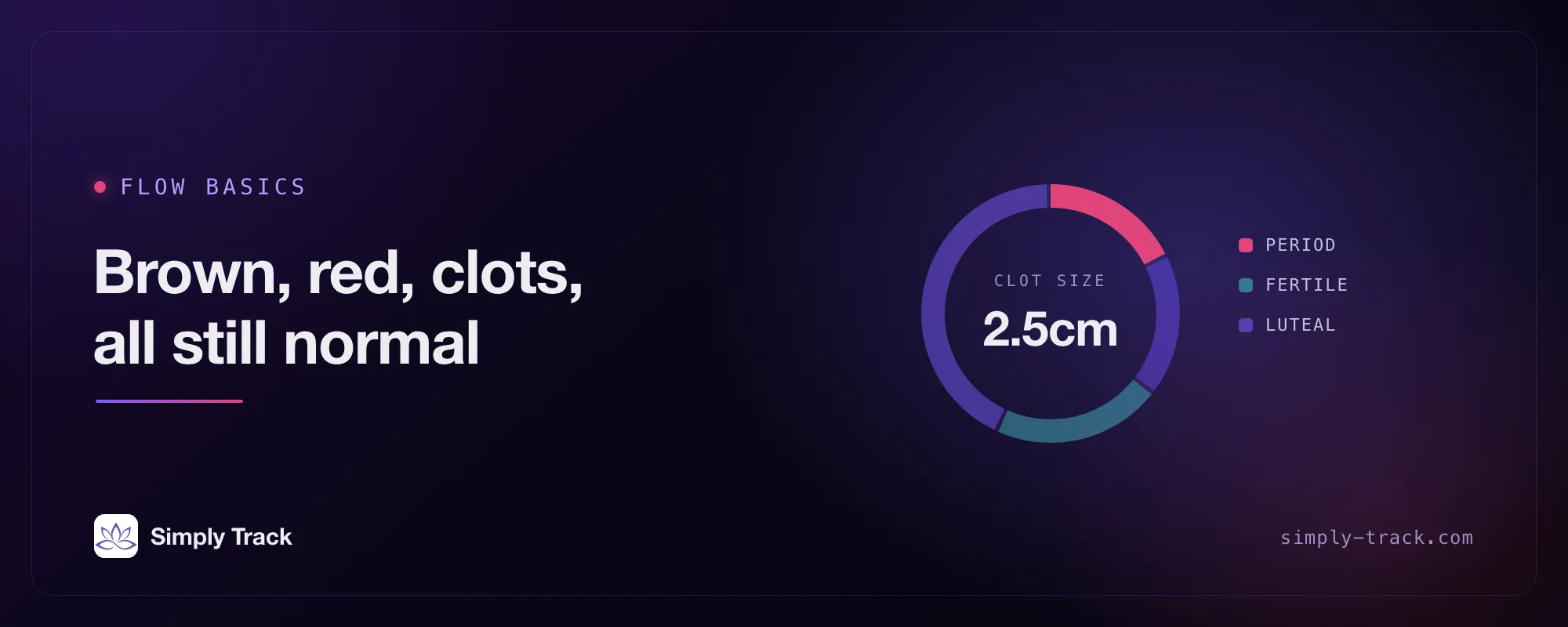
- Passing blood clots larger than about 2.5cm, roughly a 10p coin.
- Bleeding through to clothes or bedding.
- Avoiding activities or taking time off work because of your period.
- Feeling tired or short of breath.
The NHS advises seeing a GP if heavy periods are affecting your life, if they have been heavy for some time, if there is severe pain, or if you bleed between periods or after sex.
Two markers earn extra attention. Flooding, meaning leaking onto clothes or bedding despite protection, is the one people are least likely to volunteer and most likely to organise their lives around. Clot size is useful because it is checkable. A 10p coin is a real object, and it is the same marker covered in more depth in Period Blood: Colour, Clots and Smell Explained.
What is often underneath
Heavy bleeding is usually a symptom rather than a diagnosis in itself. The NHS lists fibroids, adenomyosis, endometriosis, PCOS/PMOS, pelvic inflammatory disease, bleeding disorders and certain medicines among the causes.
Fibroids are non-cancerous growths in or around the womb. They mainly affect women who have not been through the menopause, and heavy or painful periods are among their commonest signs, sometimes with lower back pain or needing to urinate more often.
Adenomyosis is the womb lining growing into the muscle of the womb wall. Its usual pairing is heavy bleeding with painful periods, and it is more commonly diagnosed in women over 30. NG88 recommends transvaginal ultrasound when it is suspected.
Endometriosis, where tissue similar to the womb lining grows elsewhere in the body, can present with heavy periods as well as severe pain, a pairing covered more fully in When Period Pain Is Not Normal. Polycystic ovary syndrome, renamed polyendocrine metabolic ovarian syndrome (PMOS) in 2026, and pelvic inflammatory disease appear on the same NHS list, and NG88 adds uterine polyps.
Bleeding disorders such as von Willebrand disease can make you bleed more easily. If periods have been heavy since the very first one, or there is easy bruising, frequent nosebleeds or a personal or family history of a bleeding disorder, say so at the appointment.
Medicines including anticoagulants can cause it, and rarely so can cancer of the womb, which is why bleeding between periods or after sex is always worth reporting.
The iron problem
Heavy periods, alongside pregnancy, are a very common cause of iron deficiency anaemia, the NHS states. Symptoms include tiredness, shortness of breath, noticeable heartbeats and paler than usual skin, and this consequence of heavy periods is easy to miss because it arrives slowly.
Those symptoms creep. Feeling wiped out for a week every month gets blamed on work, sleep, age or stress, rarely on blood loss, until someone runs a blood test.
NG88 removes the guesswork by instructing clinicians to "carry out a full blood count test for all women with HMB, in parallel with any HMB treatment offered". If you have been treated for heavy periods and never had bloods taken, it is entirely reasonable to ask why.
Where anaemia is confirmed, treatment is usually iron tablets, typically for around six months, plus dietary changes.
What investigation and treatment look like
Investigation starts with a history and a full blood count, moves to a physical exam or imaging only where they are needed, and treatment runs from hormonal options up to surgery as a last resort.
The appointment begins with a history covering the nature of the bleeding, related symptoms such as persistent bleeding between periods or pelvic pain, the impact on quality of life, and anything else that might affect treatment choices. A full blood count is arranged.
A physical examination follows where those related symptoms are present, and is required before any investigation or before fitting an intrauterine system. Where the picture is heavy bleeding alone, NG88 allows treatment to begin without one.
Imaging depends on what is suspected. Hysteroscopy, a camera passed into the womb, is preferred for submucosal fibroids, polyps or an abnormality of the womb lining. Pelvic ultrasound is used for larger fibroids, and transvaginal ultrasound for suspected adenomyosis.
Treatment in NG88 runs from the levonorgestrel-releasing intrauterine system, tranexamic acid, anti-inflammatories, combined hormonal contraception and cyclical progestogens, through to endometrial ablation, uterine artery embolisation, myomectomy and, as a last resort, hysterectomy.
Most people never reach the surgical end of that list. The point is that a real ladder exists, and it starts with a conversation.
The short version
Heavy is not a volume, it is an interference. NICE defines heavy menstrual bleeding by its effect on physical, social, emotional and material quality of life, and tells clinicians to treat that impact rather than the millilitres. Changing protection every 1 to 2 hours, doubling up on products, clots bigger than a 10p coin, flooding and bleeding beyond 7 days are the practical markers. Fibroids, adenomyosis and bleeding disorders are common explanations, iron deficiency anaemia is the common consequence, and a full blood count is recommended for everyone with heavy menstrual bleeding. All of it is treatable, and all of it starts with a GP appointment.
Take numbers with you. Simply Track's daily Log records flow, clots, products used and how the day actually went, and the doctor report turns a few months of that into a clean PDF, generated on the device and anonymous by default. Tracking and the calendar are free. The Log tab, Insights and the report are Premium. The app makes no assessment of whether your bleeding is heavy, because that is a judgement for you and your GP. It just means you can answer "how heavy, and for how long?" with a record instead of a shrug.
Sources
- NICE NG88, Heavy menstrual bleeding: assessment and management, Context: https://www.nice.org.uk/guidance/ng88/chapter/Context
- NICE NG88, Heavy menstrual bleeding: assessment and management, Recommendations: https://www.nice.org.uk/guidance/ng88/chapter/Recommendations
- NICE TA78, Scope: Endometrial ablation techniques for heavy menstrual bleeding (for the historic 80ml definition and its reliance on subjective assessment in practice): https://www.nice.org.uk/guidance/ta78/documents/scope-endometrial-ablation-techniques-for-heavy-menstrual-bleeding
- NHS, Heavy periods: https://www.nhs.uk/conditions/heavy-periods/
- NHS, Iron deficiency anaemia: https://www.nhs.uk/conditions/iron-deficiency-anaemia/
- NHS, Fibroids: https://www.nhs.uk/conditions/fibroids/
- NHS, Adenomyosis: https://www.nhs.uk/conditions/adenomyosis/
- NHS, Endometriosis: https://www.nhs.uk/conditions/endometriosis/
- NHS, Von Willebrand disease: https://www.nhs.uk/conditions/von-willebrand-disease/
Common questions
What is the medical definition of a heavy period?
NICE guideline NG88 defines heavy menstrual bleeding as excessive menstrual blood loss that interferes with a woman's physical, social, emotional or material quality of life. There is no set volume in the definition. Clinicians are told to focus on that impact rather than on measuring blood loss.
What are the practical signs of a heavy period?
The NHS lists changing a pad or tampon every 1 to 2 hours, using two products together, periods lasting more than 7 days, blood clots larger than about 2.5cm, bleeding through to clothes or bedding, and feeling tired or short of breath as signs of heavy periods worth acting on.
Can heavy periods cause anaemia?
Yes. The NHS states that heavy periods are a common cause of iron deficiency anaemia, with symptoms including tiredness, shortness of breath and paler than usual skin. NICE guideline NG88 recommends a full blood count test for everyone with heavy menstrual bleeding, alongside any treatment offered.
Not medical advice
General information, not medical advice. If something about your cycle worries you, speak to a GP.

Keep track of your own cycle
Simply Track logs your period on your iPhone and Apple Watch, and its predictions sharpen the more you record. Your data stays in your own iCloud account.