Perimenopause Starts in Your Cycle Data
Long before hot flushes, perimenopause writes itself into the gap between one period and the next. Here is what NHS, NICE and BMS guidance says to track.
Published 27 July 2026
Perimenopause usually shows up first as a change in your cycle, not a hot flush. Cycles shift by about seven days from your own norm at first, later stretching to gaps of sixty days or more.
Ask most people what perimenopause looks like and they will say hot flushes. That is the image the subject has been reduced to, and it is a late one. Long before anything that dramatic, the change writes itself into something far more ordinary: the gap between one period and the next, and that is the part almost nobody is told to watch, and the only part measurable at home.
One of the first signs is the cycle, not the flush
One of the first signs of perimenopause is usually a change to your periods, not a hot flush. The NHS is direct about this. Periods may happen more often or less often, and bleeding may get heavier or lighter. Flushes, broken sleep and low mood sit alongside that, but the calendar tends to move first.
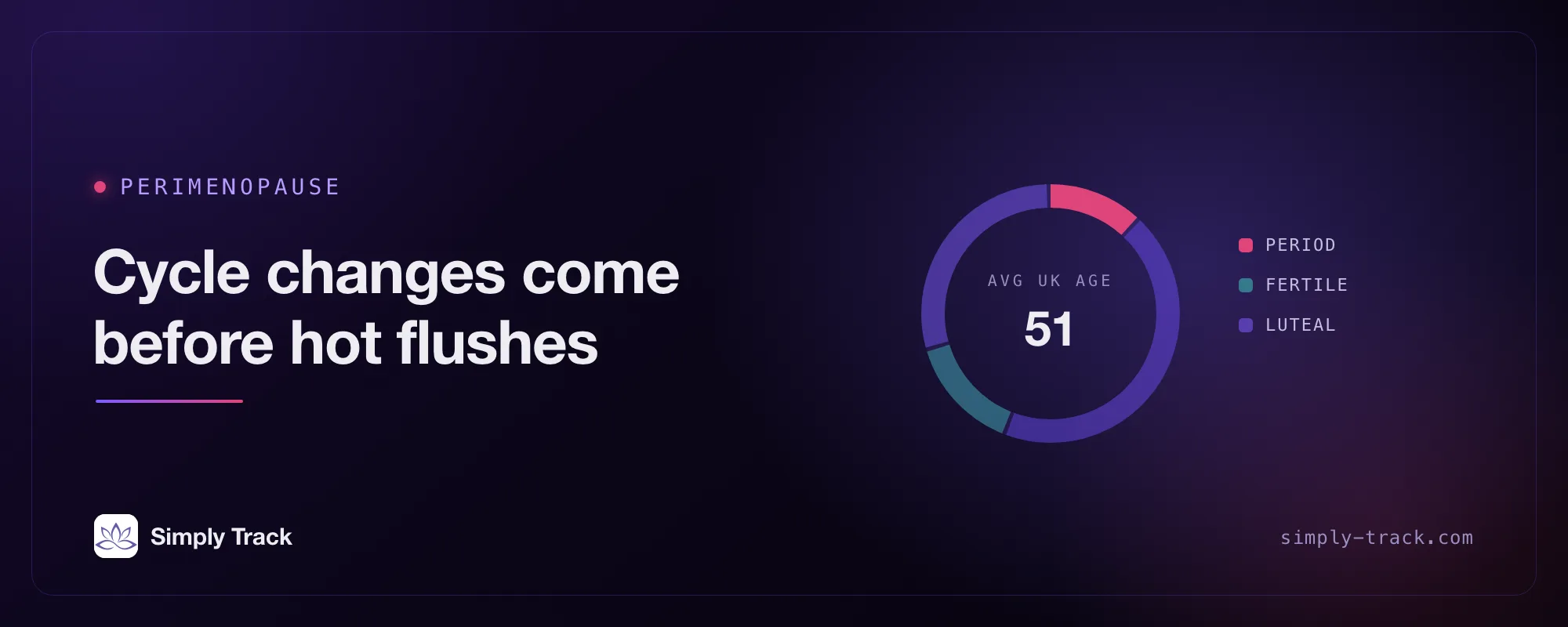
Menopause itself usually happens between 45 and 55. The British Menopause Society puts the UK average at 51, and notes the age of onset differs between ethnic groups. It can only be identified looking backwards: twelve consecutive months with no period, and not while using hormonal contraception. Everything before that is perimenopause, which Women's Health Concern, the patient arm of the BMS, says can begin in the late 30s or early 40s.
So the data that matters most is produced roughly a decade before anyone thinks to look at it.
The change has a recognised shape
The BMS describes perimenopause in three recognised stages: late reproductive, early perimenopause and late perimenopause, each marked by how much cycle length shifts. Clinicians do not treat it as one blur. In the late reproductive phase, cycle changes are subtle and many people notice nothing.
In early perimenopause, the pattern changes properly. The BMS puts the typical shift at around seven days from a person's own norm. The research staging system this draws on, the Stages of Reproductive Aging Workshop, defines that stage by a persistent difference of seven days or more between the lengths of consecutive cycles.
In late perimenopause, cycles become less frequent and periods can arrive months apart. The same staging system marks this stage by a gap of sixty days or more, and estimates it lasts on average one to three years.
Note what that sequence assumes. "Seven days from your norm" is meaningless without a norm, and so is a sixty-day gap if you cannot say when the last one was.
How long it lasts, honestly
Perimenopause itself typically lasts a few months to several years, while perimenopausal symptoms often run for seven to nine years or more. Confident numbers get quoted here that do not agree, because two different questions are being answered: how long the biological transition takes, and how long the symptoms it causes last once they start. Both numbers are correct. They just are not measuring the same thing.
The transition: RCOG describes perimenopause as lasting from a few months to several years.
The symptoms: the NHS says they usually last 7 to 9 years, sometimes longer. The BMS puts the average at more than 7 years, with more than a third of people affected beyond that.
Both answers share a timescale measured in years rather than weeks, which is why a memory-based account of it falls apart.
What the cycle shows, and what it hides
A cycle record shows length, timing and flow in detail, but it cannot see everything perimenopause affects, including bone density and heart disease risk. It is powerful and also partial. It can only report what happens where you can see it, and important parts of the transition happen where you cannot.
Cycle-visible: the length between periods, how much it varies, how long bleeding lasts, whether flow has changed (what counts as a heavy period), and anything that clusters in the days beforehand.
Not cycle-visible: bone density and cardiovascular risk. The BMS puts it bluntly. A hot flush is obvious, but osteoporosis has no obvious symptoms, and the first sign may be a fracture. Lower oestrogen after menopause has also been shown to raise heart disease risk. None of that appears in a calendar, which is why the record is a prompt for a conversation rather than a replacement for one.
Why NICE says the blood test is beside the point
At 45 and over, NICE says perimenopause is diagnosed from symptoms and cycle change, not an FSH blood test. A blood test can still be requested, but guidance does not require one, and a single reading of a hormone that fluctuates through perimenopause tells a clinician little. What you can describe about your own cycle carries the diagnosis instead.
NICE guideline NG23 says perimenopause can be diagnosed in otherwise healthy people aged 45 and over from vasomotor symptoms that have recently started together with any changes in the menstrual cycle, without laboratory tests. The related NICE quality standard is blunter still: base it on symptoms alone.
The reasoning is that follicle stimulating hormone fluctuates during perimenopause, so a single reading tells you little and will not change management. NICE also lists tests that should not be used at this age, including anti-Mullerian hormone, oestradiol and antral follicle count. FSH is reserved for narrower cases, such as people aged 40 to 45 with symptoms including a cycle change, or people under 40 where menopause is suspected.
If the diagnosis rests on symptoms and cycle change, what you can describe about your own cycle is not a nice-to-have. It is a substantial part of the clinical evidence.
What a record does to a ten-minute appointment
A dated cycle record turns a vague description into something a GP can act on inside a short appointment. Compare two versions of the same conversation, one from memory and one read from a record, and the difference is not confidence or how well someone can explain themselves. It is whether the dates were written down as they happened.
"My periods have been all over the place for a while, and I have not been sleeping."
"Over two years my cycles went from 28 days to running between 21 and 47. I have skipped two since March, bleeding is heavier, and my sleep broke around the same time."
Both describe the same body. Only one has handed a GP something to work with.
NICE tells people with suspected endometriosis that a pain and symptom diary aids discussion, and RCOG requires premenstrual symptoms to be recorded across two cycles before PMS is diagnosed. Written records are already how these conversations are meant to work.
The angle nobody mentions: contraception
Irregular cycles in your forties do not mean fertility has ended, so contraception still matters through perimenopause. That is an easy assumption to overturn, and the BMS advice on how long to continue is specific. Under 50, contraception should continue until two years have passed without a period. Over 50, one year is the threshold. Hormonal contraception can also mask the very cycle changes that would otherwise be the clearest signal, which is why a prescriber matters more here than any app screen.
Any tracker's predictions are estimates (why your period app gets the date wrong), and never a form of contraception. During perimenopause, when the underlying pattern is unstable by definition, that caveat carries more weight rather than less.
The short version
Perimenopause usually shows up first as a change in cycle pattern, often around seven days from your own normal, later stretching to gaps of sixty days or more. Menopause is confirmed retrospectively after twelve months without a period, at an average UK age of 51. At 45 and over, NICE says the diagnosis is made on symptoms and cycle change, not a blood test. The record you keep is the evidence you bring.
Start it before you need it. Speak to a GP about bleeding that gets heavier rather than lighter, or any bleeding at all once twelve months have passed without a period.
Simply Track exists to make that record easy to keep and easy to hand over. Logging a period is one tap, the calendar shows a pattern rather than a single number, and Premium adds a doctor report that turns years of dates into a clean PDF, generated on the device and anonymous by default. It does not diagnose anything. Its job is to replace vague recollection with dates a clinician can act on.
Sources
- NHS, Menopause and perimenopause: https://www.nhs.uk/conditions/menopause-and-perimenopause/what-are-menopause-and-perimenopause/
- NHS, Symptoms of menopause and perimenopause: https://www.nhs.uk/conditions/menopause-and-perimenopause/symptoms/
- NICE NG23, Menopause: identification and management, recommendations: https://www.nice.org.uk/guidance/ng23/chapter/recommendations
- NICE QS143, Quality statement 1: Diagnosing perimenopause and menopause: https://www.nice.org.uk/guidance/qs143/chapter/quality-statement-1-diagnosing-perimenopause-and-menopause
- NICE NG73, Endometriosis: diagnosis and management, recommendations: https://www.nice.org.uk/guidance/ng73/chapter/Recommendations
- RCOG, Treatment for symptoms of the menopause: https://www.rcog.org.uk/for-the-public/browse-our-patient-information/treatment-for-symptoms-of-the-menopause/
- RCOG, Managing premenstrual syndrome (PMS): https://www.rcog.org.uk/for-the-public/browse-our-patient-information/managing-premenstrual-syndrome-pms/
- British Menopause Society, Tool for Clinicians: What is the menopause?: https://thebms.org.uk/wp-content/uploads/2026/01/17-NEW-BMS-TfC-What-is-the-menopause-JAN2026-A.pdf
- Women's Health Concern (British Menopause Society), Perimenopause and menopause: your questions answered: https://www.womens-health-concern.org/wp-content/uploads/2026/04/38-NEW-WHC-FACTSHEET-Perimenopause-and-menopause-APRIL2026-A.pdf
- Harlow SD et al., Executive summary of the Stages of Reproductive Aging Workshop +10: https://pmc.ncbi.nlm.nih.gov/articles/PMC3340903/
Common questions
What is usually the first sign of perimenopause?
The NHS says one of the first signs is usually a change to your periods, often before hot flushes, broken sleep or low mood appear. Cycles may happen more or less often, and bleeding can become heavier or lighter. In early perimenopause, the British Menopause Society notes a typical shift of around seven days from your own normal cycle length.
How long does perimenopause last?
It depends which question you are asking. RCOG says the transition itself can last from a few months to several years. The NHS says perimenopausal symptoms usually last 7 to 9 years, sometimes longer, and the British Menopause Society puts the average above 7 years, with more than a third of people affected beyond that.
Do you still need contraception during perimenopause?
Yes. Irregular cycles in your forties do not mean fertility has ended. The British Menopause Society advises continuing contraception until two years have passed without a period if you are under 50, or one year if you are over 50. Hormonal contraception can also mask the cycle changes that would otherwise signal perimenopause.
Not medical advice
General information, not medical advice. If something about your cycle worries you, speak to a GP.

Keep track of your own cycle
Simply Track logs your period on your iPhone and Apple Watch, and its predictions sharpen the more you record. Your data stays in your own iCloud account.