Why Your Period App Gets the Date Wrong
Your tracker is not wrong, it is averaging. Most of a prediction's error comes from the follicular phase, the variable half of the cycle, where delayed ovulation pushes the whole date back.
Published 27 July 2026
A tracker predicts your next period by averaging the gaps between your logged cycles and projecting that forward. Nearly all the error comes from the follicular phase, the half where ovulation itself moves.
Most trackers say nothing about why a date was wrong, and that silence is the real problem. It is not a bug and it is not you. It is arithmetic doing the only thing arithmetic can do with a body.
Here is what is really happening behind that little coloured dot.
A prediction is an average wearing a costume
A period app has never seen your future. It only knows your past, and it turns the gap between your recent day ones into an average, then adds that average to your last period.
A good tracker weights recent cycles more heavily and adjusts for age, because cycle length shortens as you get older. A 2019 npj Digital Medicine analysis of 612,613 ovulatory cycles found mean cycle length fell by about 0.18 days per year of age between 25 and 45.
That is the whole trick, a rolling average dressed as a date. It is a design decision, not a claim about biology.
The Faculty of Sexual and Reproductive Healthcare, renamed the College of Sexual and Reproductive Healthcare (CoSRH) in 2025, requires a minimum of twelve recorded cycles before its calendar method can be used at all, and says the calculation should always be made on the most recent twelve. Most people install a tracker and expect a reliable date by cycle two.
One half of the cycle is stable, the other is not
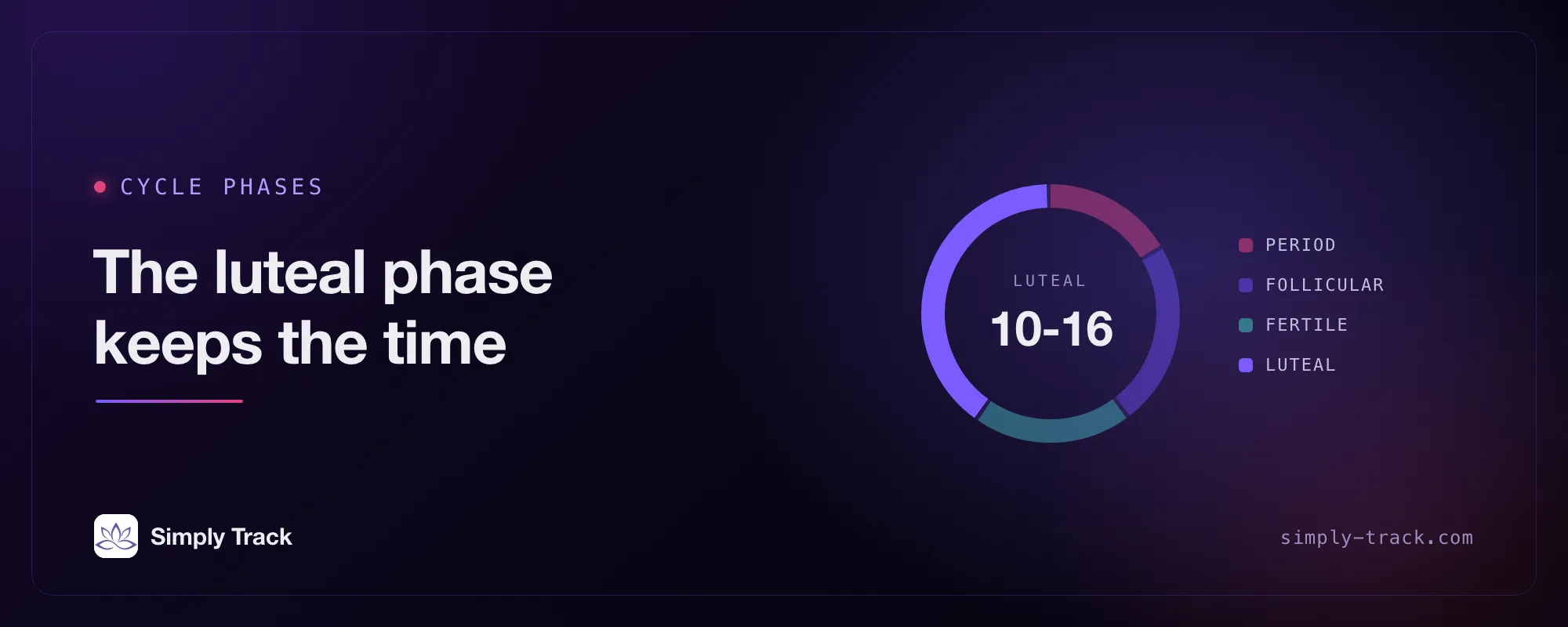
The luteal phase holds a fairly fixed length because it is governed by the corpus luteum, while the follicular phase can run from ten days to a month because it only ends when ovulation happens.
A cycle splits into two halves with very different personalities.
The luteal phase runs from ovulation to the next period. A 2019 npj Digital Medicine analysis of 612,613 ovulatory cycles found it averaged 12.4 days with a 95 per cent interval of 7 to 17 days.
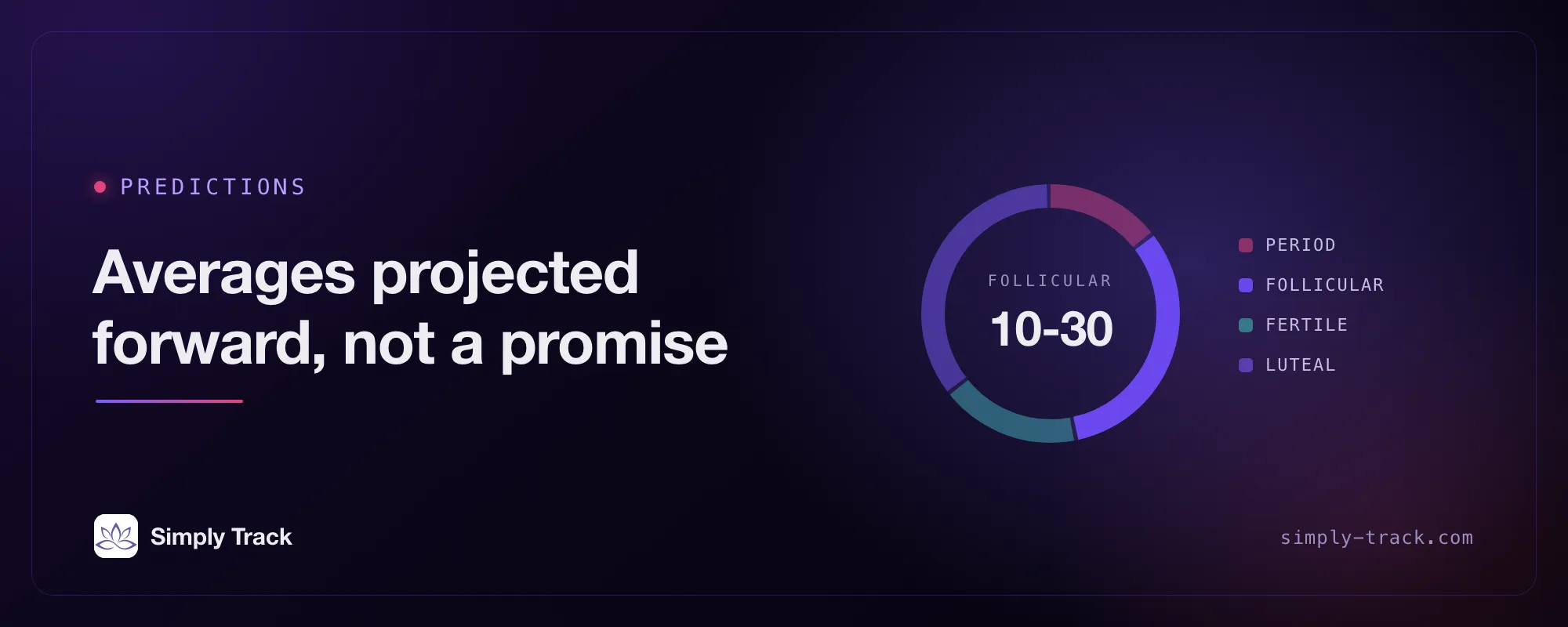
The follicular phase runs from day one to ovulation, and it is the loose one. The same analysis found it averages 16.9 days but ranges from 10 to 30. The FSRH guideline states it directly, that the follicular phase can vary in length. The paper's authors reached the same conclusion from the data, that differences in cycle length were caused predominantly by differences in the day of ovulation.
Read those two ranges together. The stable half moves by ten days at the extremes, the variable half by twenty. Almost all the uncertainty in your predicted date comes down to one event, ovulation.
This also explains something that confuses a lot of people. A late period usually is not a period behaving strangely. It is a period arriving punctually after a starting gun that fired late.
What moves ovulation
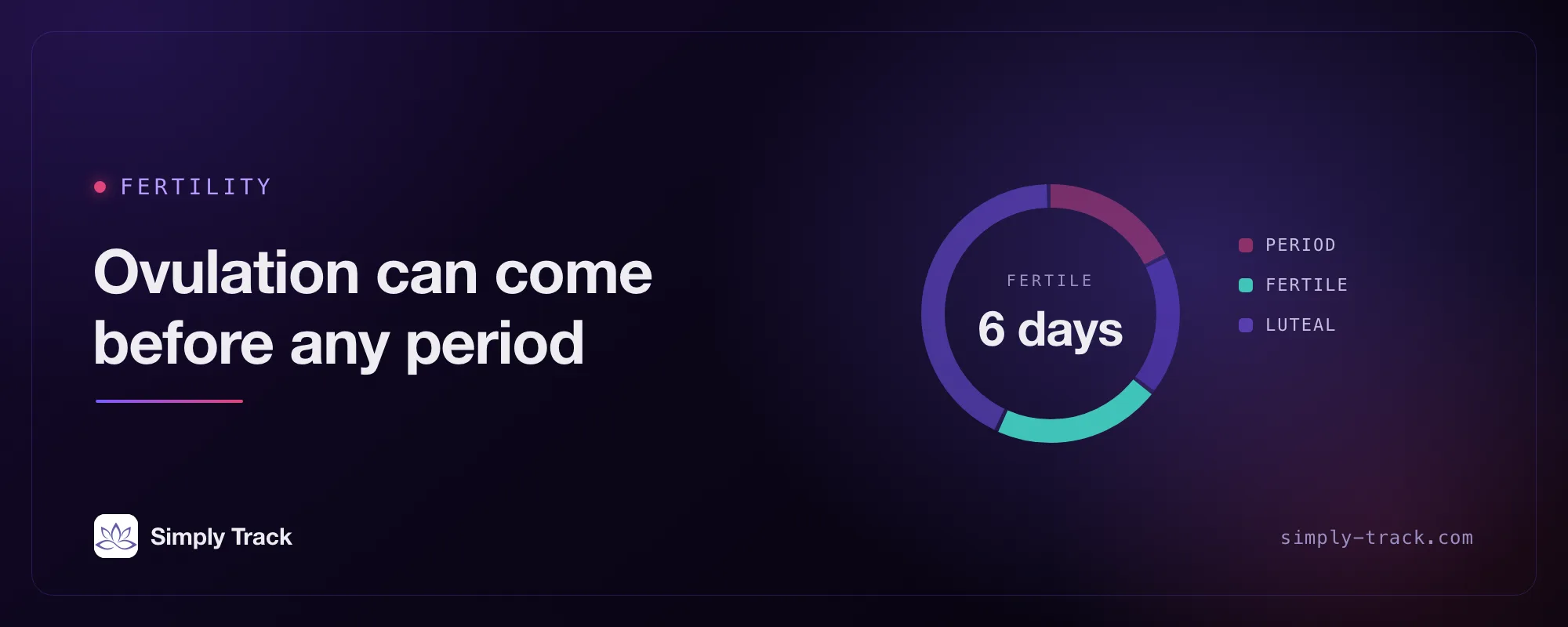
Ovulation is easily delayed. Stress, illness, travel, disrupted sleep, weight change, hormonal contraception and conditions such as thyroid problems or polycystic ovary syndrome, now polyendocrine metabolic ovarian syndrome (PMOS), can all push the day it happens later.
The NHS lists stress and anxiety, losing or gaining a lot of weight, exercising too much, hormonal contraception, and conditions such as polycystic ovary syndrome, now polyendocrine metabolic ovarian syndrome (PMOS), or thyroid problems among the reasons periods become irregular or stop. See a GP if your cycles are regularly shorter than 21 days or longer than 35 days, or stop altogether.
FSRH guidance notes that illness and infection can influence body temperature readings, and that alcohol and stress can undermine adherence to fertility awareness methods. A 2013 study of 406 Iranian pharmaceutical packaging workers found shift workers had far higher odds of a menstrual disorder than day workers, an odds ratio of 5.54 (95 per cent CI 2.78 to 11.02).
Travel, a bad fortnight, a virus, a run of four-hour nights. None of these push your period back. They push ovulation back, and the period comes along behind it. The app is not failing to see the future. It is failing to see a hypothalamus.
The honest summary is that a prediction assumes next month resembles the last few. When it does, the date lands. When your life does not cooperate, the date does not either.
Why more cycles narrow the error
A tracker's predictions sharpen with every cycle you log, because it is learning your personal average and your personal spread, not just a population rule.
Three logged cycles give an app a mean with almost nothing underneath it. Twelve give it something better: your personal spread. A 2019 npj Digital Medicine analysis of 612,613 ovulatory cycles tracked this spread, the standard deviation of each user's own cycle lengths, and found it fell by 0.5 days, or 20 per cent, between the youngest and oldest cohorts, before climbing back to 3.1 days by age 45. That is a population pattern. Your own spread might be one day or might be seven, and an app cannot know which until it has watched you for a while.
Which is the plain reason no app can predict a cycle it has never seen. Install it in March and it knows nothing about February. No amount of cleverness recovers data that was never recorded, and the only fix is time.
Two groups deserve extra patience. Adolescent cycles are still settling, and ACOG and the AAP put around 90 per cent of them between 21 and 45 days, with the first-year 95th percentile as far out as 90 days. And anyone in perimenopause, where FSRH guidance notes irregularity is common, is asking a pattern-matcher to match a pattern that is dissolving. If perimenopausal changes are worrying you, a GP can talk through what is happening.
The case for saying "probably"
A range beats a single date because a single date can only be right or wrong, while a range tells you what to expect and how confident to be.
There is a commercial temptation to show one confident date, because confidence feels like competence. It is the wrong call, for a reason that has nothing to do with modesty.
A single date cannot be wrong usefully. It is either right or a small betrayal, and after three of those people stop trusting the app, including the parts that were accurate. A range does better: it tells you what to expect and how much to bet on it, so a period arriving on day four of a five-day window means the app was correct, not lucky.
There is a harder reason too. A confident date invites a use the maths does not support. A 1996 review of calendar-based contraceptive methods identified eight cohort studies, but only five, covering 1,537 women, had data that could be pooled, and it found a twelve-month failure rate of 18.5 per cent under a conservative analysis and 15 per cent under a less conservative one. That is somewhere between one failure in five and one in seven over a year. An interface implying certainty about ovulation is not a neutral design choice against that evidence.
So it needs saying without hedging: predictions are estimates, and never a form of contraception. Not the date, not the fertile window, not the app. If you are avoiding pregnancy, use contraception and talk to a GP or a sexual health clinic about which kind.
The short version
Predictions are rolling averages projected forward, and the follicular phase is where nearly all the error comes from, because anything that delays ovulation delays the period behind it.
The luteal phase is the steady half, about 12.4 days on average. The follicular phase is the variable half, and that is where nearly all the error comes from. Accuracy improves with logged cycles and cannot exist before them. And no prediction, from any app, is contraception. A predicted date is not the only thing your cycle can tell you either: see Your Cycle Is a Vital Sign for what else the pattern reveals.
Simply Track is built on that premise rather than around it. Predictions learn your rhythm from the cycles you log and are tuned to age, and the app does not claim more certainty than your data supports. Period tracking, the calendar and every first-period guide are free, always, with no account, no ads, and data staying on the device unless synced to your own private iCloud. Premium adds daily logging, Insights and a doctor PDF for the appointment, if the pattern itself starts to worry you.
Sources
- NHS, Periods and fertility in the menstrual cycle: https://www.nhs.uk/conditions/periods/fertility-in-the-menstrual-cycle/
- NHS, Irregular periods: https://www.nhs.uk/conditions/irregular-periods/
- NHS, Missed or late periods: https://www.nhs.uk/conditions/stopped-or-missed-periods/
- FSRH, Clinical Guideline: Fertility Awareness Methods (June 2015), now published by the College of Sexual and Reproductive Healthcare (CoSRH): https://www.cosrh.org/Common/Uploaded%20files/documents/ceuguidancefertilityawarenessmethods.pdf
- Bull JR et al., Real-world menstrual cycle characteristics of more than 600,000 menstrual cycles, npj Digital Medicine 2019: https://www.nature.com/articles/s41746-019-0152-7
- Kambic RT and Lamprecht V, Calendar rhythm efficacy: a review, Advances in Contraception 1996 (NHS DARE systematic review record): https://www.ncbi.nlm.nih.gov/books/NBK66578/
- Attarchi M et al., Characteristics of menstrual cycle in shift workers, Global Journal of Health Science 2013: https://pmc.ncbi.nlm.nih.gov/articles/PMC4776814/
- ACOG and AAP Committee Opinion 651, Menstruation in Girls and Adolescents: Using the Menstrual Cycle as a Vital Sign: https://www.acog.org/clinical/clinical-guidance/committee-opinion/articles/2015/12/menstruation-in-girls-and-adolescents-using-the-menstrual-cycle-as-a-vital-sign
Common questions
Why does my period tracker predict the wrong date?
A tracker predicts from the average gap between your past cycles, not a forecast of your biology. If something delayed ovulation, such as stress, travel, illness or disrupted sleep, the period arrives later than the average suggested, and the app has no way to see that coming.
Why is the second half of my cycle more predictable than the first?
The luteal phase, from ovulation to the next period, is governed by the corpus luteum and averages around 12.4 days, ranging roughly 7 to 17. The follicular phase, from day one to ovulation, averages 16.9 days but ranges 10 to 30, so nearly all a prediction's error sits before ovulation.
How many cycles does a period app need before its predictions are reliable?
The Faculty of Sexual and Reproductive Healthcare, now the College of Sexual and Reproductive Healthcare (CoSRH), requires a minimum of twelve recorded cycles before a calendar-based method can be used at all. A tracker installed this month knows nothing about the cycles before it, so accuracy builds only as you log more.
Not medical advice
General information, not medical advice. If something about your cycle worries you, speak to a GP.

Keep track of your own cycle
Simply Track logs your period on your iPhone and Apple Watch, and its predictions sharpen the more you record. Your data stays in your own iCloud account.