Your Cycle Has Four Phases
Most people picture the cycle as bleeding, and not bleeding. It actually runs through four phases, and the second half keeps far steadier time than the first.
Published 27 July 2026
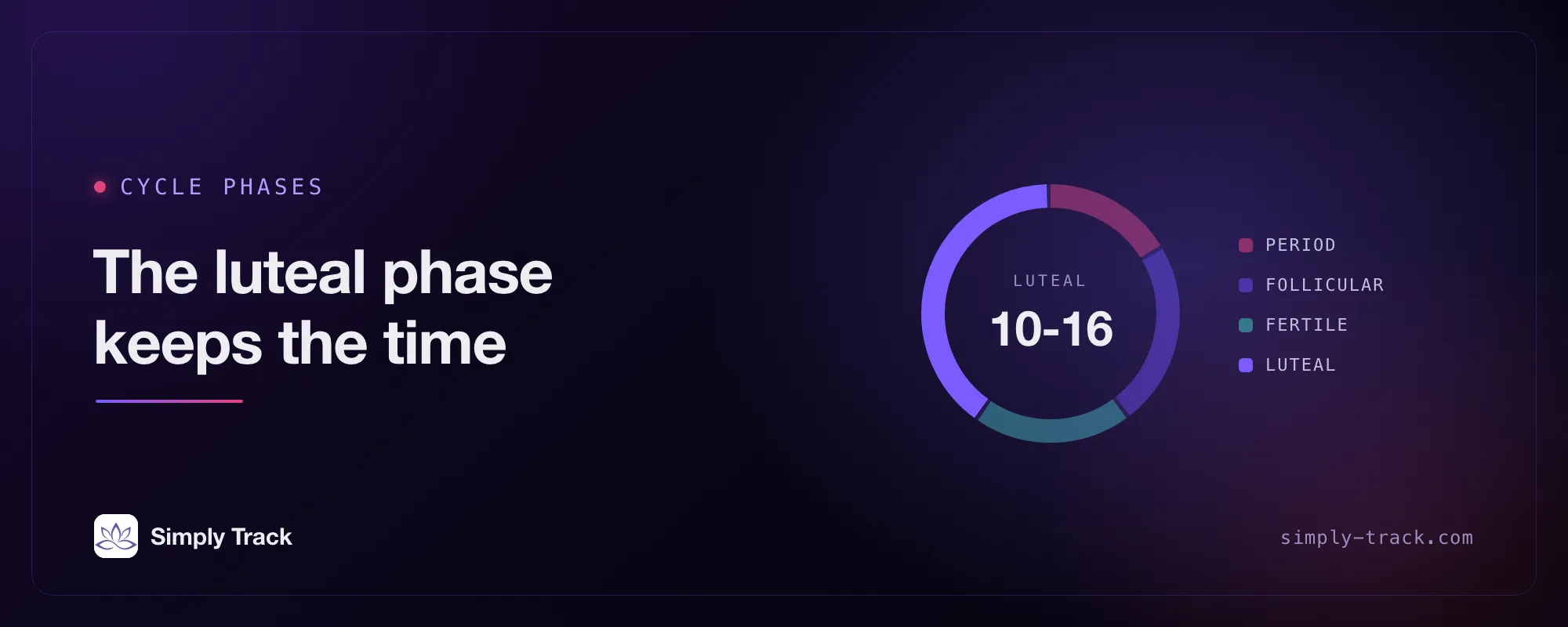
The menstrual cycle runs through four phases: menstrual, follicular, ovulatory and luteal. The luteal half keeps steady time, roughly 10 to 16 days, while the follicular half varies, which is usually why a cycle runs long or short.
Ask most adults to describe the menstrual cycle and you get two states: bleeding, and not bleeding. It is an understandable model, because only one of those states is visible. It is also wrong in a way that makes everything downstream harder to follow, including why a period arrives late and why a tracking app moves its prediction.
The bleed is the shortest of the four phases, and it is the only one anyone can see.
The bleed is an ending as much as a beginning
The period is the womb lining shedding once progesterone from the previous cycle withdraws, not a new event starting from nothing.
Day one of the cycle is the first day of the period. The NHS is unambiguous: the menstrual cycle is the time from the first day of one period to the day before the next, and the average is around 28 days, with regular cycles anywhere from 21 to 35 days counting as normal.
The bleed itself, though, is the closing act of the cycle before it. Through the whole second half of that previous cycle, progesterone was holding the womb lining in place in case a fertilised egg arrived. When none did, the structure making that progesterone broke down and the hormone withdrew. The Society for Endocrinology describes the consequence directly: as the lining of the womb is no longer maintained by progesterone from the corpus luteum, it breaks away and menstrual bleeding occurs.
So a period is not the body starting something. It is the body finishing something, and the numbering convention just happens to put the full stop at the front of the sentence.
The follicular phase is the part nobody names
The follicular phase runs from the end of the period to ovulation, as follicle stimulating hormone drives follicle growth and rising oestrogen rebuilds the womb lining.
Overlapping the bleed and running on well past it is the follicular phase. Follicle stimulating hormone rises and stimulates a group of follicles in the ovary to grow, and one of them will release an egg at ovulation. As the follicles develop they produce oestradiol, the main form of oestrogen.
Two things follow. The womb lining, freshly shed, begins thickening again. And the climbing oestrogen becomes a signal in its own right.
This phase has no external marker at all. Nothing bleeds, nothing aches, nothing announces itself. Nearly all the variation in cycle length lives here.
The surge that releases the egg
A surge in luteinising hormone, triggered by high oestrogen, causes the ovarian follicle to rupture and release a mature egg.
Once oestradiol has been high enough for long enough, the feedback loop flips. Instead of damping down the pituitary gland, oestrogen starts to provoke it, and the result is a sharp surge in luteinising hormone.
That surge is the event. The Society for Endocrinology puts it at around day 14 of a textbook cycle, when the rise in luteinising hormone causes the ovarian follicle to rupture and release a mature egg. The NHS gives the same day 14 for someone with a regular 28-day cycle, and adds the more useful version for everyone else: in most people, ovulation happens around 10 to 16 days before the next period.
Both describe a model, not a rule. Ovulation is not scheduled by the calendar but by how long the follicles took to get ready.
Some people feel it happen. The NHS describes ovulation pain, also called mittelschmerz, as a dull pain or sharp sudden twinge on one side of the tummy, lasting from a few minutes to a day or two, and switching sides depending on which ovary released the egg. Cervical secretions change around the same point, becoming thinner and stretchier, a bit like raw egg white. Many people notice nothing at all. Any fertile window built from these signals is an estimate, and never a form of contraception.
The luteal phase is a countdown, not a wait
The luteal phase is the roughly 10 to 16 days after ovulation when the corpus luteum produces progesterone to prepare and maintain the womb lining, then breaks down if no pregnancy begins.
The ruptured follicle does not simply vanish. It reorganises into the corpus luteum, literally the yellow body, and under continued luteinising hormone it produces progesterone.
Progesterone's task is preparation. It turns a thickened lining into a receptive one and holds it in that state. If an embryo implants, the corpus luteum keeps working until the placenta takes over. If nothing implants, the corpus luteum has a limited working life, breaks down, and progesterone falls away.
The end of the luteal phase and the start of the next period are the same event described twice.
The luteal phase keeps time, the follicular phase moves
The luteal phase holds a fairly fixed length for most people, while the follicular phase stretches or shortens, so a late period usually means ovulation arrived late rather than the second half running long.
Here is the angle that changes how you read your own numbers. The two halves of the cycle are not equally variable.
An analysis of 612,613 ovulatory cycles from 124,648 users, published in npj Digital Medicine in 2019, reported a mean cycle length of 29.3 days. It broke that down into a mean follicular phase of 16.9 days, with a 95 per cent confidence interval running from 10 to 30 days, and a mean luteal phase of 12.4 days, with an interval of 7 to 17 days.
Ignore the means for a moment and read the spreads. The follicular phase ranges across roughly twenty days. The luteal phase ranges across ten. The NHS arrives at a similar picture from the other direction when it says the time from the release of an egg to the start of a period is around 10 to 16 days.
The practical consequence is significant. A late period is usually not a stretched second half. It is delayed ovulation, which pushed everything after it back by the same amount. Illness, disrupted sleep, travel and stress act on the follicular phase, and the luteal phase then runs its usual length from wherever ovulation landed.
Clinicians already work backwards from that fact. NICE guidance on fertility problems asks for a serum progesterone blood test in the mid-luteal phase, given as day 21 of a 28-day cycle. It tells them to move it later for prolonged irregular cycles, for example day 28 of a 35-day cycle, repeating weekly until the next period starts. The test is not really anchored to day 21. It is anchored to the end of the cycle.
The short version
Four phases make one loop: menstrual, follicular, ovulatory and luteal, and the luteal phase is the steady one.
Menstrual: progesterone has fallen, so the lining is released. Follicular: follicle stimulating hormone grows follicles, oestrogen rises, the lining rebuilds. Ovulatory: oestrogen triggers a luteinising hormone surge and a follicle releases an egg. Luteal: the corpus luteum makes progesterone, then breaks down, and the loop closes.
The second half is the steady part, at roughly 10 to 16 days for most people. The first half does the wandering. If your cycle length changed, the explanation almost always sits before ovulation rather than after it. And if cycles that were settled become erratic, stop for months, or turn painful enough to interrupt normal life, that is a conversation for a GP rather than an app. Cycle length is only one part of what a cycle can tell you: see Your Cycle Is a Vital Sign for what else it reveals.
Simply Track was built around that loop rather than around a red block on a calendar. Period tracking, the calendar and every first-period guide are free. Insights, the daily Log tab and the doctor PDF report come with Premium. There is no account and no advertising, and your cycle data stays on your device unless you choose to sync it to your own private iCloud. Predictions learn your rhythm rather than assuming 28 days, and they remain estimates, never a form of contraception.
Sources
- NHS, Periods and fertility in the menstrual cycle: https://www.nhs.uk/conditions/periods/fertility-in-the-menstrual-cycle/
- NHS, Periods: https://www.nhs.uk/conditions/periods/
- NHS, Ovulation pain: https://www.nhs.uk/symptoms/ovulation-pain/
- Society for Endocrinology, You and Your Hormones, Follicle stimulating hormone: https://www.yourhormones.info/hormones/follicle-stimulating-hormone/
- Society for Endocrinology, You and Your Hormones, Luteinising hormone: https://www.yourhormones.info/hormones/luteinising-hormone/
- Society for Endocrinology, You and Your Hormones, Progesterone: https://www.yourhormones.info/hormones/progesterone/
- Bull JR et al., Real-world menstrual cycle characteristics of more than 600,000 menstrual cycles, npj Digital Medicine 2019: https://www.nature.com/articles/s41746-019-0152-7
- NICE NG257, Fertility problems: assessment and treatment, recommendations 1.18.7 and 1.18.8: https://www.nice.org.uk/guidance/ng257
Common questions
What are the four phases of the menstrual cycle?
The cycle runs through the menstrual (bleeding) phase, the follicular phase, ovulation, and the luteal phase. Bleeding happens when progesterone withdraws and the womb lining is shed. The follicular phase then rebuilds the lining as oestrogen rises, ovulation releases an egg, and the luteal phase produces progesterone until the next period begins.
How long does the luteal phase usually last?
The luteal phase, from ovulation to the next period, runs fairly consistently at around 10 to 16 days for most people, according to the NHS. A 2019 study of over 600,000 cycles found a mean luteal phase of 12.4 days, with a 95 per cent range of 7 to 17 days.
Why does a period sometimes arrive later than expected?
A late period is usually delayed ovulation, not a stretched second half. The follicular phase, before ovulation, varies far more than the luteal phase, so illness, travel, disrupted sleep or stress push ovulation back and the whole cycle lengthens with it, while the luteal phase keeps its usual length.
Not medical advice
General information, not medical advice. If something about your cycle worries you, speak to a GP.

Keep track of your own cycle
Simply Track logs your period on your iPhone and Apple Watch, and its predictions sharpen the more you record. Your data stays in your own iCloud account.