Can You Get Pregnant on Your First Period?
Ovulation can happen before anyone has seen a period, so pregnancy is possible from a first period, not only once cycles have settled down.
Published 27 July 2026
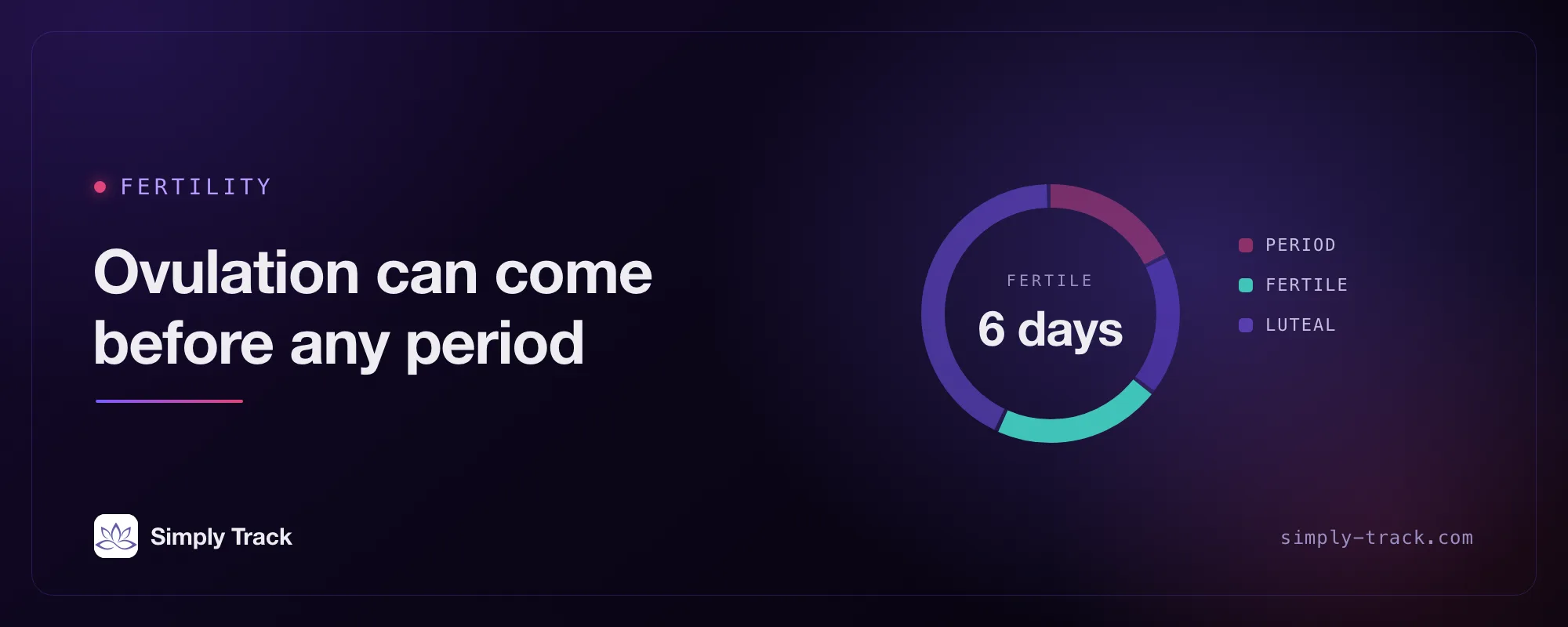
Yes. Ovulation is the release of an egg. It can happen roughly two weeks before a period, and sometimes even before any period has ever shown. This means your body can already be capable of pregnancy by the time your first period arrives.
Why a first period does not mean the risk starts here
A body does not wait for a first period before it can conceive. If ovulation happens in a cycle, conception is already possible in the two weeks before. According to the NHS, "when a girl starts her periods it's a sign that her body is now able to have a baby." That describes a process that has been building, not a switch that flips on the day bleeding starts. In a cycle where an egg is released, the body builds a lining in case of pregnancy. The bleeding that follows is what happens if that egg was not fertilised. Nobody can tell from the outside whether a given cycle, including a first one, included ovulation.
Why ovulation usually comes before the blood
In most people, ovulation happens around 10 to 16 days before a period, according to the NHS. So when a cycle includes ovulation, its fertile window closes well before any bleeding shows. In an average cycle that includes ovulation, an egg is released roughly midway through. Pregnancy can only happen in the days around that release. If sperm meets the egg, pregnancy can begin. If it does not, the lining that was building up sheds around two weeks later. That shedding is the period itself. The fertile window always sits before the bleeding, in any cycle that includes ovulation. Nobody can tell from the outside whether a given cycle was one of those. That means working backwards from a period to judge safety does not hold up, especially in a body still finding its rhythm.
Can pregnancy happen before the very first period shows?
Yes, rarely, because in some cycles the first ovulation happens before any bleeding has ever been seen. It cannot be predicted, and it cannot be ruled out in advance either. Not every period is preceded by ovulation, especially in the first year or two. That means there is no outward sign that clearly confirms whether an egg has been released. This is very uncommon. The signs a first period is close tend to show up months ahead, giving fair warning. But they are not proof that ovulation has not already quietly started. Waiting for a first period as a sign that pregnancy is impossible is not a safe assumption.
Why the first year or two is hard to predict
Cycles are least predictable in the first year or two after periods start. Nobody, not even the person having them, can say for certain where ovulation will fall. A joint committee opinion from ACOG and AAP puts around 90 per cent of teenage cycles between 21 and 45 days. In the first year after periods start, the 95th percentile for cycle length stretches to 90 days. Many early cycles do not involve ovulation at all, which is part of what makes them so irregular. That cuts both ways. It also means there is no safe pattern to count on. For more on what a first period and that first year usually involve, see the complete guide to your first period.
Does sex during a period carry any risk?
It is possible, though less likely than around ovulation, particularly if your cycle is short or irregular. The NHS notes that sperm can survive inside the body for up to 7 days after sex. It also notes that pregnancy soon after a period ends is possible, if ovulation happens early or a cycle runs short. Your body may still be settling into its rhythm, with cycle length swinging widely from month to month. That makes it harder to rule out an overlap. The tail of one period can sit close to the start of the next fertile window. That overlap is easier to rule out once cycles have settled. Nine period myths, debunked covers this one alongside a few others worth knowing.
Is a period-tracking app a form of contraception?
No, never. Simply Track, like any period app, predicts likely dates from patterns already logged. Those predictions are tuned to age as the patterns build up. That is useful for understanding a cycle and getting ready for what comes next. Predictions are estimates, and never a form of contraception. Anyone who wants to avoid pregnancy needs a method that is actually designed and fitted for that purpose. An app that estimates dates from the past is not that method.
Where to get a straight answer
Contraception advice from the NHS is free and confidential, including for anyone under 16. A sexual health clinic, most pharmacies or a GP surgery that offers it can talk you through the options without judgement. The NHS is clear about this. What gets discussed will not be passed on to parents or carers, unless someone's safety is at risk. Talking to a trusted adult first, such as a parent, a carer or a school nurse, can help too. But it is not a requirement before you ask for help directly.
The short version
- Pregnancy becomes possible once ovulation happens, and that is before the bleeding, not after it.
- That includes a first period, and, rarely, even the days just before it.
- The first year or two of periods is the least predictable stretch there is. Timing cannot be judged by memory or by an app.
- No period tracker, Simply Track included, works as contraception.
- NHS contraception advice is free, confidential and available to under-16s, through a sexual health clinic, most pharmacies or a GP surgery that offers it.
Simply Track is built to make sense of a first period and the unpredictable months that follow. The moment you tell it "it's my first period", it opens a free, step-by-step guide. Period tracking and the calendar stay free for good. Premium adds a daily Log, Insights and a doctor-ready PDF report for anyone who wants the fuller picture over time. None of it, including the predictions, is contraception. It is a way to understand a cycle, not to manage a pregnancy risk.
Sources
- NHS, Starting your periods: https://www.nhs.uk/conditions/periods/starting-periods/
- NHS, Periods and fertility in the menstrual cycle: https://www.nhs.uk/conditions/periods/fertility-in-the-menstrual-cycle/
- ACOG and AAP Committee Opinion 651, Menstruation in Girls and Adolescents: Using the Menstrual Cycle as a Vital Sign: https://www.acog.org/clinical/clinical-guidance/committee-opinion/articles/2015/12/menstruation-in-girls-and-adolescents-using-the-menstrual-cycle-as-a-vital-sign
- NHS, Where to get contraception: https://www.nhs.uk/contraception/where-to-get-contraception/
Common questions
Can you get pregnant before your first period has even started?
It is possible, though rare and hard to predict. When a cycle includes ovulation, it happens before the bleeding, so on rare occasions the very first ovulation happens before any period has ever been seen, with no way to know in advance that it has.
Can you get pregnant while you are on your first period?
It is possible, though less likely than around ovulation. The NHS notes sperm can survive for up to 7 days, and early cycles can be short and irregular enough that the next fertile window sits closer to the bleeding than expected.
Does using a period app instead of contraception count as protection?
No, never. Predictions are estimates built from patterns already logged over time, useful for understanding a cycle and planning ahead, not for avoiding pregnancy. Anyone who wants to avoid pregnancy needs a method that is actually designed and fitted for that job, available free and confidentially from the NHS.
Not medical advice
General information, not medical advice. If something about your cycle worries you, speak to a GP.

Keep track of your own cycle
Simply Track logs your period on your iPhone and Apple Watch, and its predictions sharpen the more you record. Your data stays in your own iCloud account.