Preparing Your Daughter for Her First Period
When to start talking, what to pack in a simple kit, what counts as normal in the first year, and the handful of signs worth a GP visit.
Published 27 July 2026
The best preparation starts before her first period, not after. That means early conversations, a simple kit ready, a clear sense of what counts as normal in year one, and a note of the signs worth a GP visit.
Start the conversation before it starts
Start talking around the time the first signs of puberty appear, not when her period actually arrives. The NHS says periods typically begin about two years after breast development starts, so those early changes are your cue, not the period itself.
That two-year runway matters. It means the conversation does not have to be one dramatic talk delivered under pressure. You have time to bring it up naturally, in the car, while shopping, or alongside a book or school lesson she has already had. The goal is that by the time it happens, none of it is a surprise. If her dad is having this conversation too, our dad's guide to a first period covers the same ground from his side.
Keep it little and often
Short, repeated conversations work better than one big talk. A single sit-down can feel like an event, and events invite awkwardness. Mention it in passing, a few times, over several months. That normalises it instead.
Answer what she actually asks, in the words she uses, and leave the door open for more later. You do not need to cover everything at once. Products, school logistics, feelings and what blood actually looks like can each have their own short conversation instead of one overwhelming briefing.
Pack a simple starter kit together
A small kit in her school bag removes the panic from a first period arriving at an inconvenient moment. A few pads, a spare pair of dark underwear and a small pouch to keep it all together are enough to start with.
Building it with her, rather than for her, doubles as a natural conversation and lets her see exactly what is inside before she ever needs it. Our school period kit checklist covers what to include and where to keep it. Our guide to choosing a first period product compares pads, tampons, period underwear and cups if you want to talk through the options together.
What a normal first year looks like
Periods are often irregular for the first year or two, and that is expected rather than a fault. According to ACOG and AAP joint guidance, Committee Opinion 651, about 90 per cent of adolescent cycles fall between 21 and 45 days apart. In that first year, the longest gaps can stretch towards 90 days as the body finds its rhythm.
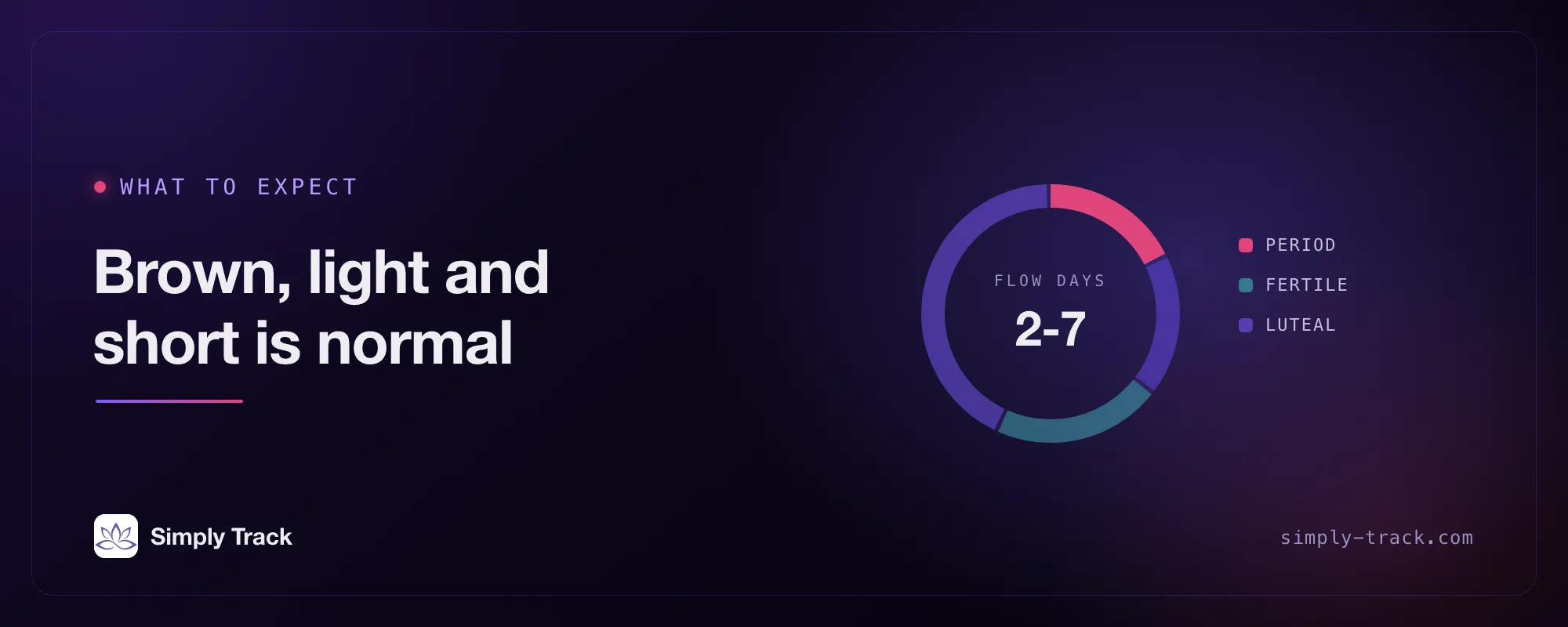
Once things settle, the NHS describes a typical cycle as one that arrives every 23 to 35 days and lasts 2 to 7 days. Knowing both ranges in advance means an early gap of six or eight weeks between periods does not read as a problem when it is usually just timing. Our complete first-period guide walks through what to expect in more depth, from that first stain through to a settled cycle.
When it is worth a GP visit
Most of what happens in the first year is normal, but a few signs are worth a GP appointment. The NHS recommends seeing a GP if periods have not started by age 15, or by 13 if there are no other signs of puberty yet.
Two other markers matter once periods have started. Needing to change a pad or tampon every 1 to 2 hours is one of the NHS markers of a heavy period. It is worth raising with a GP. Severe period pain, the kind that stops her doing her usual daily activities rather than pain that is merely uncomfortable but manageable, is also a reason to see a GP. Do not just wait it out. None of this is common in a healthy first year, but knowing the line in advance means you will recognise it if you see it.
Celebrate without the embarrassment
Treat her first period as ordinary, healthy news, not a big occasion or a secret. A first period is not an illness. Do not make a fuss over it in front of other people, but do not hide it away in silence either.
Follow her lead. Some girls want it acknowledged warmly and briefly. Others would rather it was never mentioned again after the first conversation. Either is fine. What matters is that she comes away knowing this is normal and healthy, however you choose to mark it, or not at all.
The short version
Start talking at the first signs of puberty, roughly two years ahead. Keep the conversations short and frequent rather than one big talk. Build a simple kit together. Expect irregularity for the first year, typically 21 to 45 days between periods, settling towards every 23 to 35 days. See a GP if periods have not started by 15, or by 13 with no other puberty signs, or if bleeding or pain crosses the lines above. Mark the moment gently, on her terms.
Simply Track is built around exactly this moment. Answering "it's my first period" during setup opens a free, step-by-step guide to what is happening and how to use pads, tampons, cups and more. That part of the app is free, always, alongside period tracking and the calendar. If you want to set it up with her, the daily log, deeper insights and a doctor-ready PDF report sit behind Premium, but the first-period guide itself never does. Once it is set up, it is genuinely hers. No account is needed, her data is never sold, and it stays on her device unless she chooses to sync it privately to her own iCloud.
Sources
- NHS, Starting your periods: https://www.nhs.uk/conditions/periods/starting-periods/
- NHS, Irregular periods: https://www.nhs.uk/symptoms/irregular-periods/
- NHS, Heavy periods: https://www.nhs.uk/conditions/heavy-periods/
- NHS, Period pain: https://www.nhs.uk/symptoms/period-pain/
- ACOG/AAP, Committee Opinion No. 651: Menstruation in Girls and Adolescents: Using the Menstrual Cycle as a Vital Sign: https://www.acog.org/clinical/clinical-guidance/committee-opinion/articles/2015/12/menstruation-in-girls-and-adolescents-using-the-menstrual-cycle-as-a-vital-sign
Common questions
What age should I start the conversation?
There is no fixed age. NHS guidance puts the first period around two years after the first signs of puberty, often breast development, so a natural moment is as soon as you notice those changes starting, whatever age that turns out to be for her.
What if she tells her friends before me?
That is normal, not a sign anything has gone wrong. Plenty of girls talk to friends first because it feels lower stakes. Keep the door open at home so she still has the facts and a kit ready, whoever she told first.
Should I track her cycle for her?
No, it works best as hers. Set an app up together if that helps her get started, but the cycle, the data and who sees it belong to her, not to you. Ownership builds the habit that keeps her using it, and it means she decides who sees her entries, including you.
Not medical advice
General information, not medical advice. If something about your cycle worries you, speak to a GP.

Keep track of your own cycle
Simply Track logs your period on your iPhone and Apple Watch, and its predictions sharpen the more you record. Your data stays in your own iCloud account.