Build Your School Period Kit
Everything to pack in a small school period kit, from pads and spare underwear to a habit that keeps it stocked, plus a version for lending to a friend.
Published 27 July 2026
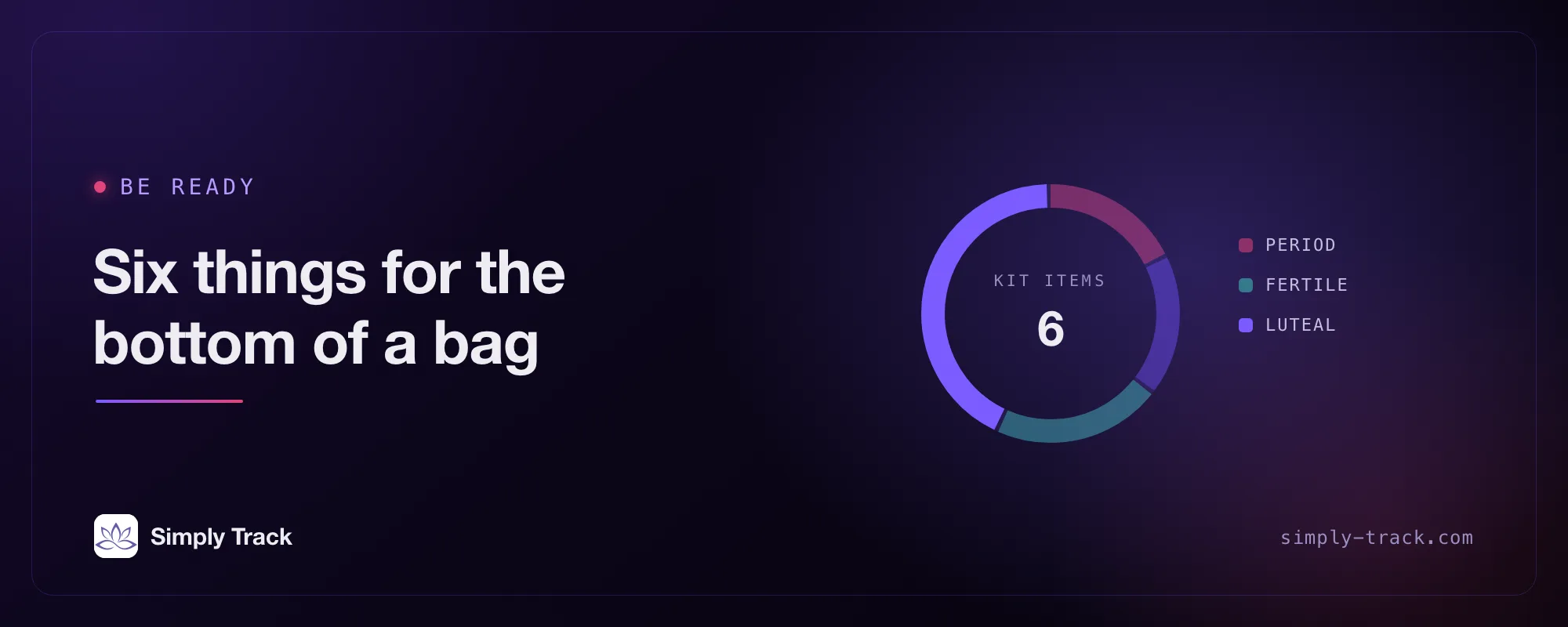
A school period kit fits in a small pouch: 2 to 3 pads or tampons, spare dark underwear, wipes, a sealable bag and a hair tie. Pack it once and it is ready whenever a period starts unexpectedly.
Whether you are putting one together for yourself or helping a teenager get ready, the same short list works term after term. None of it needs to be expensive or complicated.
What goes in the kit
A basic kit needs six things: a pouch, 2 to 3 pads or tampons, spare dark underwear, a sealable bag, wipes and a hair tie. Each item earns its place.
A small zip pouch or pencil case keeps everything together and out of sight when a bag opens. Two or three pads or tampons are usually enough for most days. According to the NHS, a first period is often light spotting rather than a heavy flow. It looks more like a reddish-brown stain than a sudden gush. If pads are not the only product on the list, see the guide to choosing a first period product. It covers tampons, cups and period underwear too.
Spare dark underwear solves the most common worry: a visible mark. Nobody else needs to notice. A sealable bag has two jobs. It keeps spare items clean, and it gives a used pad or stained item somewhere private to go until it reaches a bin. Wipes cover a quick clean-up when there is no time to get to a sink. The NHS advises against leaving a tampon or cup in for longer than needed or recommended. So it is worth using a spare between lessons rather than saving one for later. Pads are worth changing on a similar schedule, for comfort and hygiene. That specific NHS advice is about tampons and cups, not pads, but the same habit helps there too. A hair tie is small but useful. It can tie a jumper round a waist or just keep hair out of the way.
Pain relief only belongs in the kit if a parent or guardian has agreed to it and shown how much to take. The NHS lists painkillers such as paracetamol or ibuprofen as an option for period pain. It advises seeing a GP if pain ever stops the usual daily routine.
Where to keep it
Keep the kit in the main school bag, not a locker, so it travels between lessons. A locker is not always there at the exact moment it is needed.
A small zip pocket inside the main bag means the kit is there at break, at lunch and between classes. No detour needed. A second kit left with a trusted adult is a sensible backup. It helps on the day the first kit runs out or gets left at home. That adult could be a form tutor, the school office or the school nurse.
Build a kit for a friend
A friend's emergency kit needs far less: one pad or tampon, a couple of wipes, and a small sealable bag to carry a used one home discreetly. It should be small enough to pass over without anyone noticing.
Being caught out is common, and it is rarely anyone's fault. A period can start early, supplies can run out, or a bag can get left in the wrong room. Keeping a spare or two specifically to lend out means nobody has to ask twice. For the wider version of this, the calm plan for a first period at school covers the moment itself. It includes what to say and do if it happens during a lesson.
Make restocking a habit
Check the kit at the start of every half term, and refill it straight after using anything from it, so it is never empty when it matters. A habit beats a memory.
Pairing the check with something already routine, like packing new stationery or washing school uniform, makes it easier to remember. Tracking cycles with an app such as Simply Track can also give a rough estimate of when a period is likely. That is a useful nudge to check the kit is still full before it is needed.
Low-cost versions
A kit does not need to cost anything extra: own-brand products are cheap, and UK schools are increasingly required or funded to provide period products free. Asking is normal, not embarrassing.
In England, state-maintained schools and colleges can order free period products through a government-funded scheme run by the Department for Education. In Scotland, the Period Products (Free Provision) (Scotland) Act 2021 goes further. It places a legal duty on every school to make period products available free to any pupil or student who needs them. Even without a formal scheme, the school office, a form tutor or the school nurse often has spare supplies for this exact situation.
The short version
Pack a pouch with 2 to 3 pads or tampons, spare dark underwear, a sealable bag, wipes and a hair tie, and add pain relief only with a guardian's say-so. Keep it in the school bag itself, and restock it after every use. Keep a smaller version ready to lend to a friend.
Simply Track's first-period guide is always free. It walks through exactly this kind of practical preparation, as well as what a first period actually looks like. The free calendar helps track when a period is due, so restocking the kit becomes a habit rather than a scramble. For anyone starting periods for the first time, the complete first-period guide is the place to start.
Sources
- NHS, Starting your periods: https://www.nhs.uk/conditions/periods/starting-periods/
- NHS, Toxic shock syndrome: https://www.nhs.uk/conditions/toxic-shock-syndrome/
- NHS, Period pain: https://www.nhs.uk/conditions/period-pain/
- GOV.UK, Period product scheme for schools and colleges in England: https://www.gov.uk/government/publications/period-products-in-schools-and-colleges/period-product-scheme-for-schools-and-colleges-in-england
- Legislation.gov.uk, Period Products (Free Provision) (Scotland) Act 2021: https://www.legislation.gov.uk/asp/2021/1
Common questions
What should I keep in my school bag for my period?
A small zipped pouch with 2 to 3 pads or tampons, a spare pair of dark underwear, a sealable bag and some wipes covers most days. Add a hair tie for tying a jumper round your waist if you need to.
What if my school has no vending machine or dispenser?
Ask at the school office, a form tutor, or the school nurse if there is one, since many keep spare pads for this exact reason. In England, state schools can also order free period products through a government scheme, and Scotland guarantees free access by law.
What should go in a friend's emergency kit?
One pad or tampon, a small sealable bag to carry a used one home discreetly, and a couple of wipes is usually enough for most situations. Keep the kit small and unlabelled so it is easy to pass over quietly between lessons without drawing attention.
Not medical advice
General information, not medical advice. If something about your cycle worries you, speak to a GP.

Keep track of your own cycle
Simply Track logs your period on your iPhone and Apple Watch, and its predictions sharpen the more you record. Your data stays in your own iCloud account.